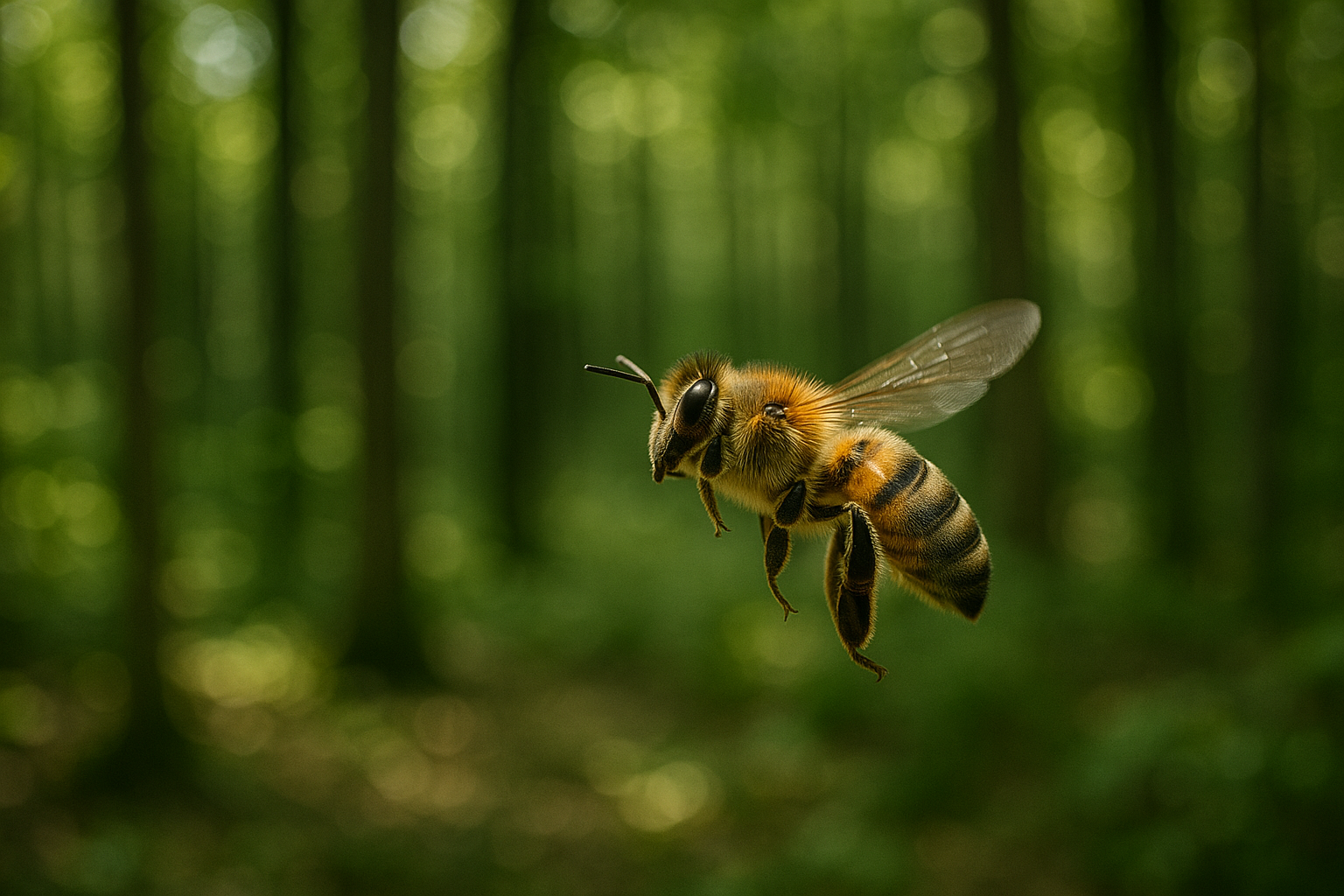
The history of the genus Apis is an epic of relentless movement and adaptation. Recent whole-genome sequencing and phylogeographic studies have largely shifted the scientific consensus, suggesting that the cradle of the honeybee lies not in Asia, but in Africa. Approximately 6 to 8 million years ago—coinciding with the era when human ancestors first walked upright—the honeybee began its own “Exodus,” navigating the cracks of global climate shifts to spread its wings across the world.
This “Great Dispersal” was a strategic expansion through ancient corridors, where genetic diversity was both lost and forged, resulting in the complex global map of subspecies we observe today.
🐝 Table of Contents
- 🌍 1. Out of Africa — The Genomic Cradle
- ❄️ 2. Glacial Refugia — The Divergence of Evolutionary Lineages
- 🌳 3. The Asian Radiation — Open Nests and Cavity Dwellers
- 🧬 4. Adaptive Introgression — The Genetic Cost of Conquest
- ✨ A Poetic Reflection
🌍 1. Out of Africa — The Genomic Cradle
Modern genetic mapping reveals that honeybee populations in Africa possess the highest level of genetic diversity. According to the principles of the “Founder Effect,” this identifies Africa as the primary source of the species.
- Ancient Corridors: Utilizing periods when the Sahara was a lush savannah, early bees migrated northward and eastward into Eurasia in multiple waves.
- Lineage A: The ancestral African lineage remains the genetic reservoir for the species, characterized by high swarming rates and resilience to tropical pathogens.
❄️ 2. Glacial Refugia — The Divergence of Evolutionary Lineages
The Pleistocene ice ages acted as a powerful evolutionary filter. As ice sheets advanced, bee populations were pushed into isolated “refugia” in the Mediterranean and Middle East.
- The Four Lineages: This isolation led to the emergence of the four major genetic branches: Lineage A (Africa), M (Western/Northern Europe), C (Eastern Europe), and O (Middle East).
- Climatic Adaptation: Each lineage reconfigured genes related to circadian rhythms and foraging thresholds to match local seasonal cycles and temperature extremes.
🌳 3. The Asian Radiation — Open Nests and Cavity Dwellers
While one branch conquered the West, another radiated throughout Asia, finding diverse ecological niches in tropical and subtropical environments.
- Speciation: This led to the emergence of the giant honeybee (Apis dorsata) and the dwarf honeybee (Apis florea), which utilize open-air nesting strategies.
- Cavity Nesting: The evolution of the ability to nest in dark cavities (caves or hollow trees) was the decisive innovation that allowed the ancestors of Apis mellifera and Apis cerana to survive harsher, temperate climates.
🧬 4. Adaptive Introgression — The Genetic Cost of Conquest
As honeybees spread, they didn’t just inhabit new lands; they genetically absorbed the lessons of the environment through adaptive introgression.
By interbreeding with established local populations, spreading lineages acquired beneficial alleles for cold tolerance and local floral recognition. This genetic flexibility transformed Apis into a global infrastructure for pollination, capable of supporting biomes from the rainforest to the boreal forest.
✨ A Poetic Reflection
Those tiny wings drew a map across continents, etching the memory of flowers into the desert sands.
🐝→ Next Post (Apis 4: The Western Sovereign)
🐝← Previous Post (Apis 2: The Co-evolutionary Pact)
🐝→ Back to Series: The Apis Records
コメント