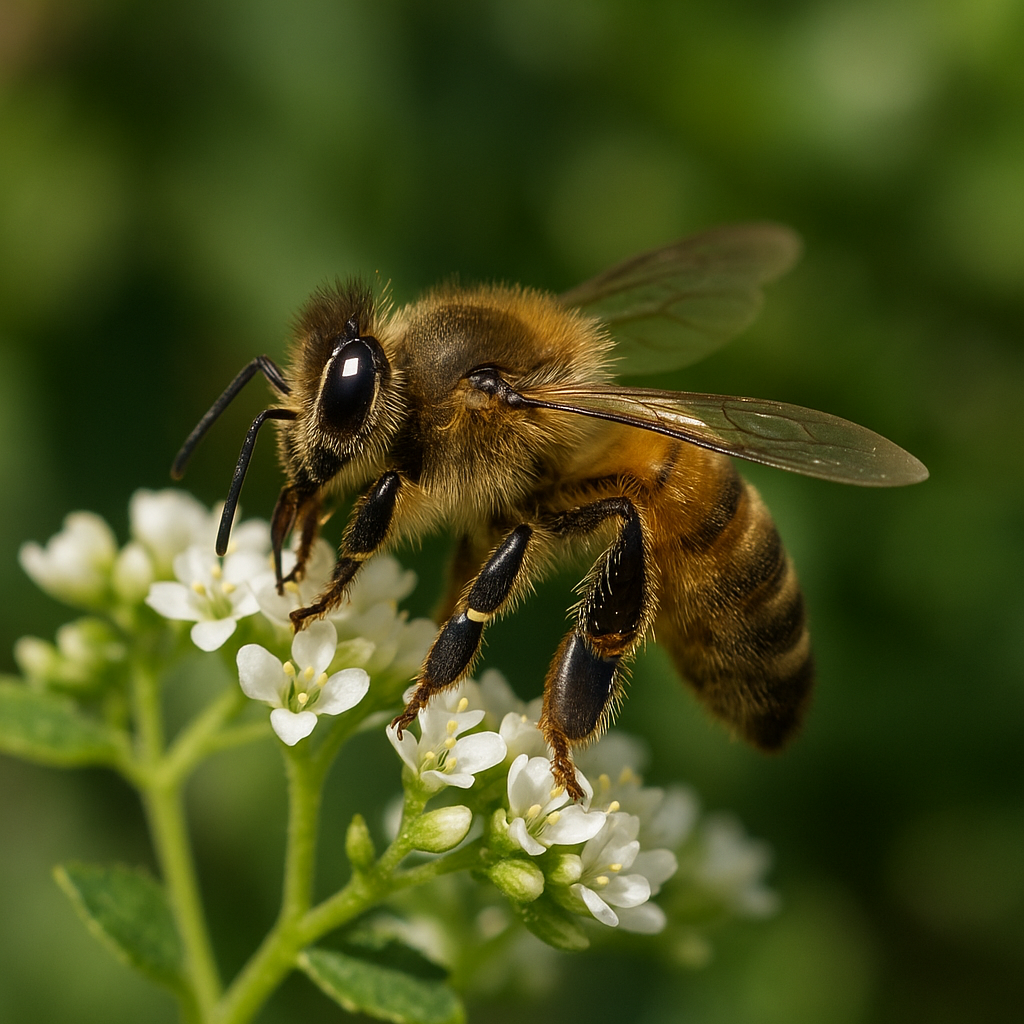
The quiet survivor of the East, Apis cerana—the Asiatic honeybee—is a master of defensive evolution, forged in the crucible of Asian ecosystems. For millions of years, they have co-evolved alongside the world’s most formidable predators: giant hornets of the genus Vespa. While their Western cousins prioritized industrial efficiency and expansion, Apis cerana perfected the art of “calculated retaliation.” Their most iconic achievement is a thermodynamic weapon—the “heat-ball”—where collective kinetic energy is converted into a lethal cage of fire.
| 📊 Academic Data Sheet: Apis cerana | |
|---|---|
| Scientific Name | Apis cerana (Fabricius, 1793) |
| Common Name | Eastern Honey Bee / Asiatic Honey Bee |
| Native Range | East, South, and Southeast Asia |
| Body Size | Approx. 10–12 mm (Smaller than A. mellifera) |
| Specialized Trait | Thermal Defense (Heat-balling) against Vespa |
| Climate Adaptation | High tolerance to cold/misty conditions in mountain forests |
To understand Apis cerana is to understand a resilience built on precision rather than brute force, a lineage that has mastered the fine line between absolute destruction and survival.
🐝 Table of Contents
- 🌡️ 1. The Physics of the Heat-Ball — Lethal Thermal Margins
- 💨 2. Atmospheric Warfare — CO2 and Respiratory Stress
- 📡 3. The Shimmering Screen — Visual Deception and Communication
- 🏔️ 4. The Highland Sentinel — Cold Tolerance and Ecological Niche
- ✨ A Poetic Reflection
🌡️ 1. The Physics of the Heat-Ball — Lethal Thermal Margins
When a hornet scout approaches, Apis cerana workers do not flee; they engulf the predator in a dense sphere of hundreds of bees. By vibrating their flight muscles, they raise the core temperature of the ball to approximately 46°C.
- The Survival Gap: Giant hornets have a lethal thermal limit between 44°C and 46°C, whereas Apis cerana can endure up to 48–50°C. The bees execute their enemy within this narrow 4-degree margin of survival.
- Kinetic Mastery: This is a sophisticated application of social homeostasis repurposed for biological execution.
💨 2. Atmospheric Warfare — CO2 and Respiratory Stress
Recent studies indicate that heat is not the only weapon within the ball. The concentration of CO2 rises sharply, acting as a catalyst for death.
- Synergistic Lethality: High CO2 levels lower the hornet’s thermal tolerance, ensuring a faster kill and minimizing the risk to the worker bees at the core of the struggle.
📡 3. The Shimmering Screen — Visual Deception and Communication
To prevent an attack before it begins, Apis cerana utilizes a synchronized visual display known as “shimmering.”
- Wave Dynamics: Workers across the hive entrance shake their abdomens in coordinated waves, creating a flickering effect that disrupts the hornet’s visual tracking and target acquisition.
- Absconding: If pressure becomes too great, Apis cerana is famously prone to “absconding”—abandoning the hive entirely to start anew, a flexible strategy that ensures the survival of the genetic line over the physical structure.
🏔️ 4. The Highland Sentinel — Cold Tolerance and Ecological Niche
Unlike the introduced A. mellifera, the Asiatic bee is highly adapted to the erratic climates of Asian mountain forests. They remain active in lower temperatures and light drizzle, maintaining pollination services for indigenous flora that would otherwise be neglected.
Their presence is the silent guardian of Asian forest biodiversity, a resilient gear in an ancient and unforgiving machine.
✨ A Poetic Reflection
It is the hottest of silences—an execution where life crosses the threshold of fire to save itself.
🐝→ Next Post (Apis 6: Giants of the Cliffs)
🐝← Previous Post (Apis 4: The Western Sovereign)
🐝→ Back to Series: The Apis Records
コメント