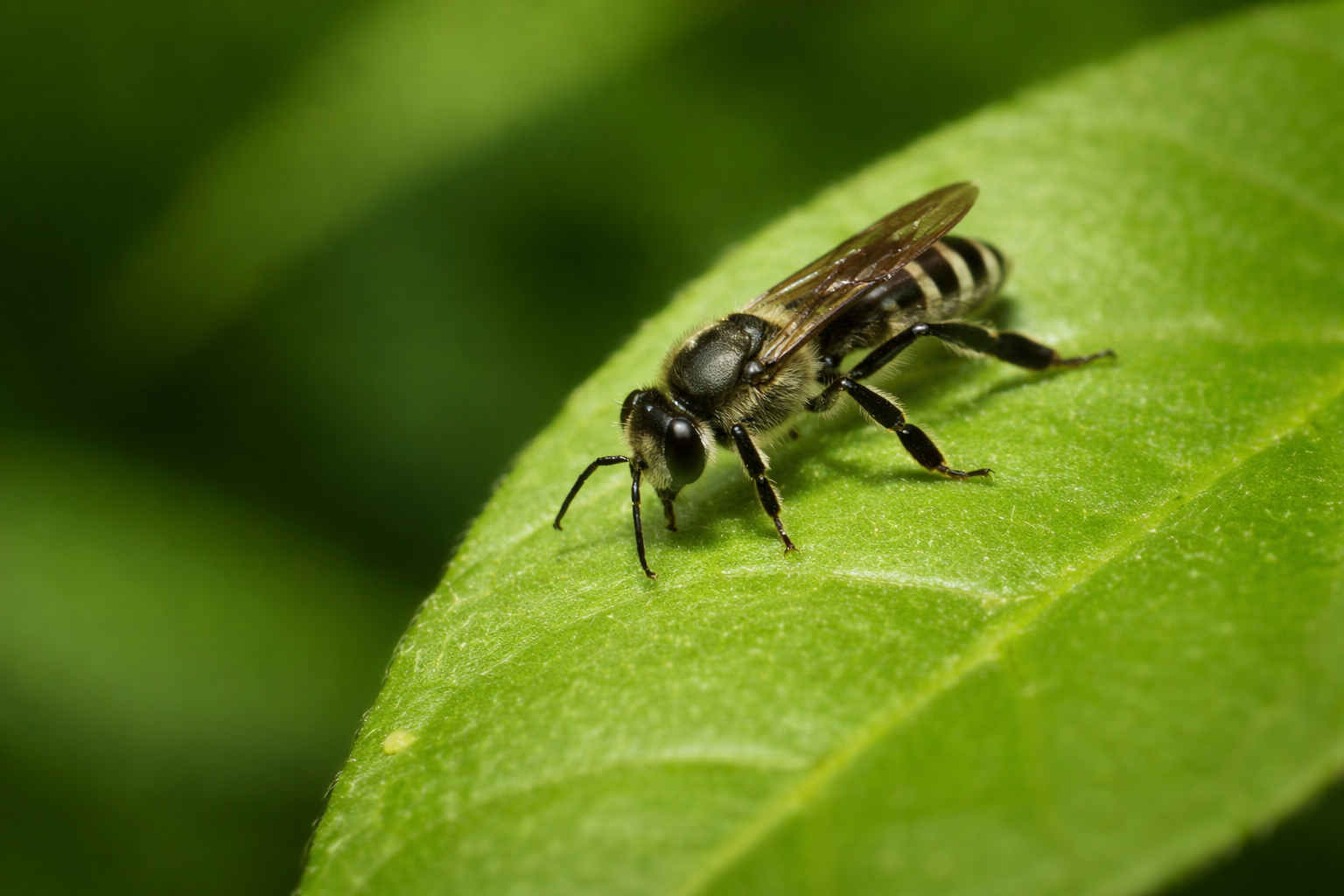
In the dense, multi-layered rainforests of Southeast Asia, where sunlight struggles to penetrate the emerald canopy, a tiny, jet-black specter thrives. Apis andreniformis—the Black Dwarf Honey Bee—is a master of the understory’s gloom. While closely related to the more common Apis florea, this species has claimed the shadows as its exclusive domain. By choosing the dark, humid interior of the jungle over the sun-drenched fringes, they have secured an ecological niche that protects them from direct competition and defines their unique evolutionary path.
📊 Data Profile: Apis andreniformis
- Scientific Name: Apis andreniformis (Smith, 1858)
- Common Name: Black Dwarf Honey Bee
- Body Color: Distinctively black with silver-white hairs on the hind legs
- Nesting Preference: Deep shade, typically 1–3 meters above the forest floor
- Geographical Range: Primarily Southeast Asia and Southern China
- Key Trait: High sensitivity to habitat disturbance and light levels
To understand Apis andreniformis is to recognize the power of “niche partitioning”—a biological strategy where even the smallest difference in preference ensures a lineage’s survival in a crowded world.
🐝 Table of Contents
- 🌑 1. The Strategy of Darkness — Concealment through Melanism
- 🌳 2. Micro-Habitat Specialization — Life in the Forest Floor
- ⚖️ 3. Niche Partitioning — A Hundred Millimeters of Separation
- 🛡️ 4. Defensive Shimmering — The Warning in the Shadows
- ✨ A Poetic Reflection
🌑 1. The Strategy of Darkness — Concealment through Melanism
Unlike the reddish-brown hues of their sister species, Apis andreniformis is strikingly black. This is not mere aesthetics but a refined tool for crypsis in low-light environments.
- Visual Concealment: In the dim light of the rainforest interior, a black exoskeleton effectively breaks up the bee’s outline, making it nearly invisible to visual predators such as birds and crab spiders.
- Thermal Efficiency: While the forest floor is humid and cool, the black chitin allows the bee to rapidly absorb any fleck of sunlight that breaks through the canopy, maintaining the thoracic temperature required for flight.
🌳 2. Micro-Habitat Specialization — Life in the Forest Floor
Their nesting habits are a direct reflection of their preference for stability over exposure. They typically build their small, open-air combs in the dense foliage of shrubs and low-hanging vines.
- Low-Altitude Nesting: Most nests are found within 3 meters of the ground, nestled in the thickest parts of the undergrowth to avoid the desiccating heat of the upper canopy.
- Sensitivity: They are far more susceptible to habitat loss than other bees; the clearing of the primary forest understory directly translates to the disappearance of their ancestral nesting sites.
⚖️ 3. Niche Partitioning — A Hundred Millimeters of Separation
The coexistence of A. florea and A. andreniformis is a classic example of character displacement. Despite their physical similarities, they avoid competition through spatial and environmental segregation.
By evolving to thrive in higher humidity and lower light intensities, the Black Dwarf Honey Bee acts as the primary pollinator for a specific suite of “shade-loving” flora that larger, sun-seeking bees often overlook. This separation ensures that even the darkest corners of the rainforest receive the biological services of the hive.
🛡️ 4. Defensive Shimmering — The Warning in the Shadows
When threatened, the colony performs a “shimmering” behavior similar to its larger cousins. However, in the darkness of the forest, the rhythmic movement of thousands of jet-black bodies creates a haunting, metallic flickering effect.
This behavior serves as a powerful visual deterrent, signaling to intruders that the shadows themselves are occupied by a coordinated and defensive superorganism. It is a warning born of the dark, effective and absolute.
✨ A Poetic Reflection
It is a scent of flowers blooming in the abyss, known only to those who have turned their backs to the sun.
🐝→ Next Post (Apis 10: Island Endemics)
🐝← Previous Post (Apis 8: The Miniature Architects)
🐝→ Back to Series: The Apis Records
コメント