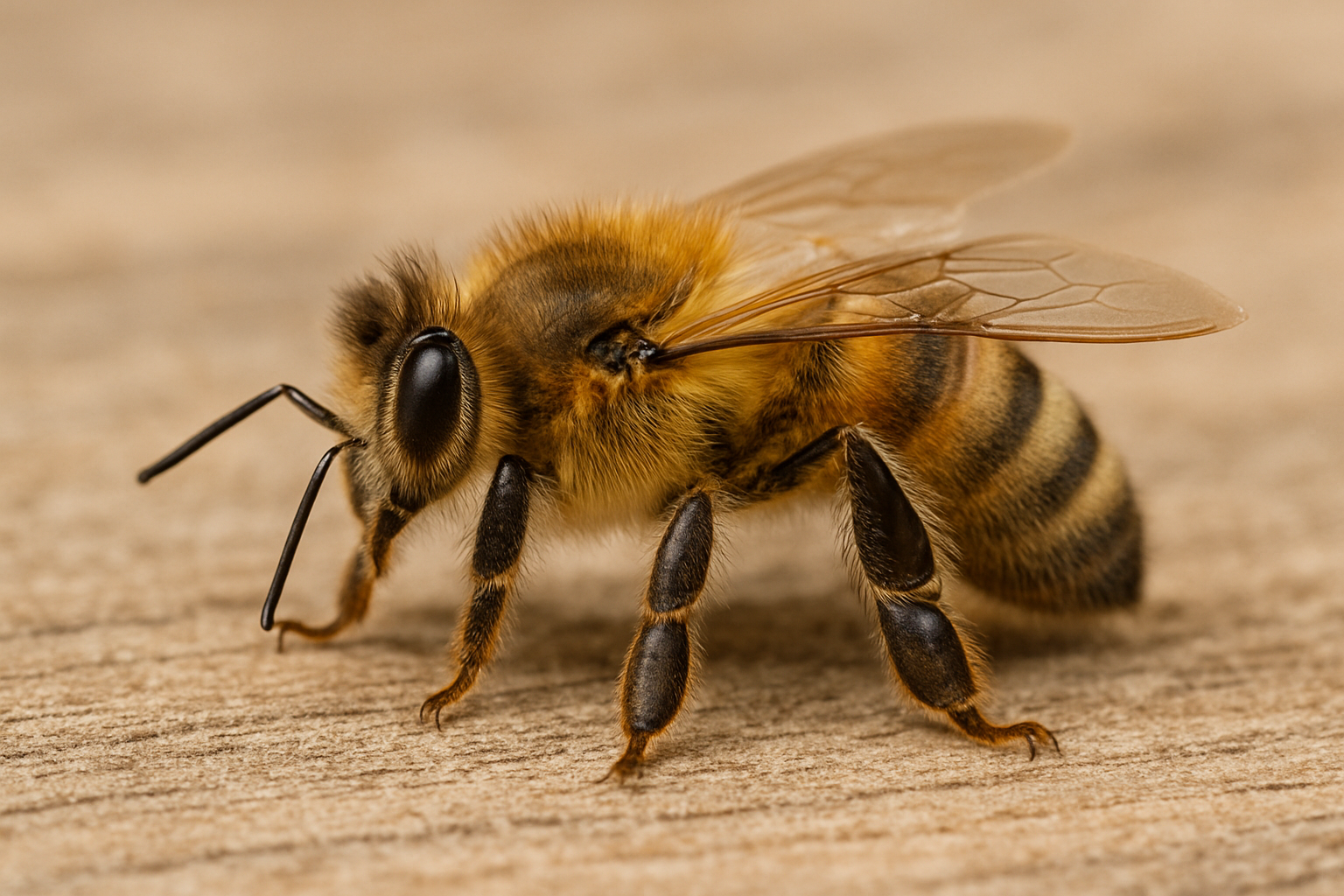
Inside the pitch-black darkness of the hive, the honeybee identifies thousands of nestmates, monitors the health of the queen, and detects the faintest hint of an intruder—all without using its eyes. This mastery of the unseen is achieved through the antennae, a pair of sophisticated biological “radars.” For Apis, the antenna is simultaneously a nose, an ear, and a linguistic decoder. It is a site of nano-scale engineering where thousands of sensory structures transform a fog of invisible molecules into a precise stream of data.
To examine the chemical antenna is to explore a sensory threshold where individual molecules trigger collective action, and where the silence of the forest is revealed to be a cacophony of aromatic signals.
🐝 Table of Contents
- 🔬 1. The Sensilla Matrix — Nano-Pores and Molecular Recognition
- 📡 2. Pheromonal Decoding — The Language of the Social Organism
- 👂 3. The Johnston’s Organ — Hearing through the Vibration of Air
- 🧭 4. Stereochemical Navigation — Smelling in Three Dimensions
- ✨ A Poetic Reflection
🔬 1. The Sensilla Matrix — Nano-Pores and Molecular Recognition
The surface of the antenna is a dense landscape of specialized receptors known as sensilla. The most critical for the honeybee are the Sensilla placodea—plate-like structures containing thousands of microscopic pores.
- Odorant Binding: Volatile molecules from flowers or pheromones enter these pores and bind to specific Odorant Receptor Neurons (ORNs). Each receptor is tuned to specific chemical functional groups, allowing for a resolution of parts-per-billion.
- High Sensitivity: This enables the bee to distinguish between nearly identical floral scents, ensuring they remain loyal to high-yield nectar sources.
📡 2. Pheromonal Decoding — The Language of the Social Organism
For a honeybee, the antenna is a social interface. It constantly scans for hundreds of distinct pheromones that maintain the hierarchy and safety of the hive.
From the “Queen Mandibular Pheromone” (9-ODA) that suppresses worker reproduction to the sharp “Alarm Pheromone” (isoamyl acetate) that signals a call to arms, the antennae act as the primary hardware for social software. When these molecules reach the antennal lobe of the brain, they trigger immediate, pre-programmed behavioral responses across the entire colony.
👂 3. The Johnston’s Organ — Hearing through the Vibration of Air
The antenna is not purely a chemical sensor; it is also a sophisticated acoustic receiver. Located at the pedicel (the second segment) is the Johnston’s organ.
This organ detects the mechanical deflection of the antennal flagellum caused by near-field air particle velocity. When a scout bee performs the “Waggle Dance,” her sisters use their antennae to “hear” the frequency of her wingbeats, translating the vibrations into data about the distance to the floral target. It is a hybrid sensor, bridging the gap between chemistry and physics.
🧭 4. Stereochemical Navigation — Smelling in Three Dimensions
Bees do not just smell; they smell in 3D. By comparing the timing and concentration of molecules arriving at the left and right antennae, they perform “stereo-olfaction.”
This spatial chemical mapping allows a bee to track an odor plume to its source through a complex environment. It is the same principle as human hearing for locating sound, repurposed for the chemical world, providing a navigational certainty that guides the bee from the hive to the bloom and back again.
✨ A Poetic Reflection
It is a fingertip reading the silent melody of the wind—a receiver for the fragrant words that fill the abyss.
🐝→ Next Post (Apis 15: The Toxic Barometer)
🐝← Previous Post (Apis 13: Spectral Vision)
🐝→ Back to Series: The Apis Records


コメント