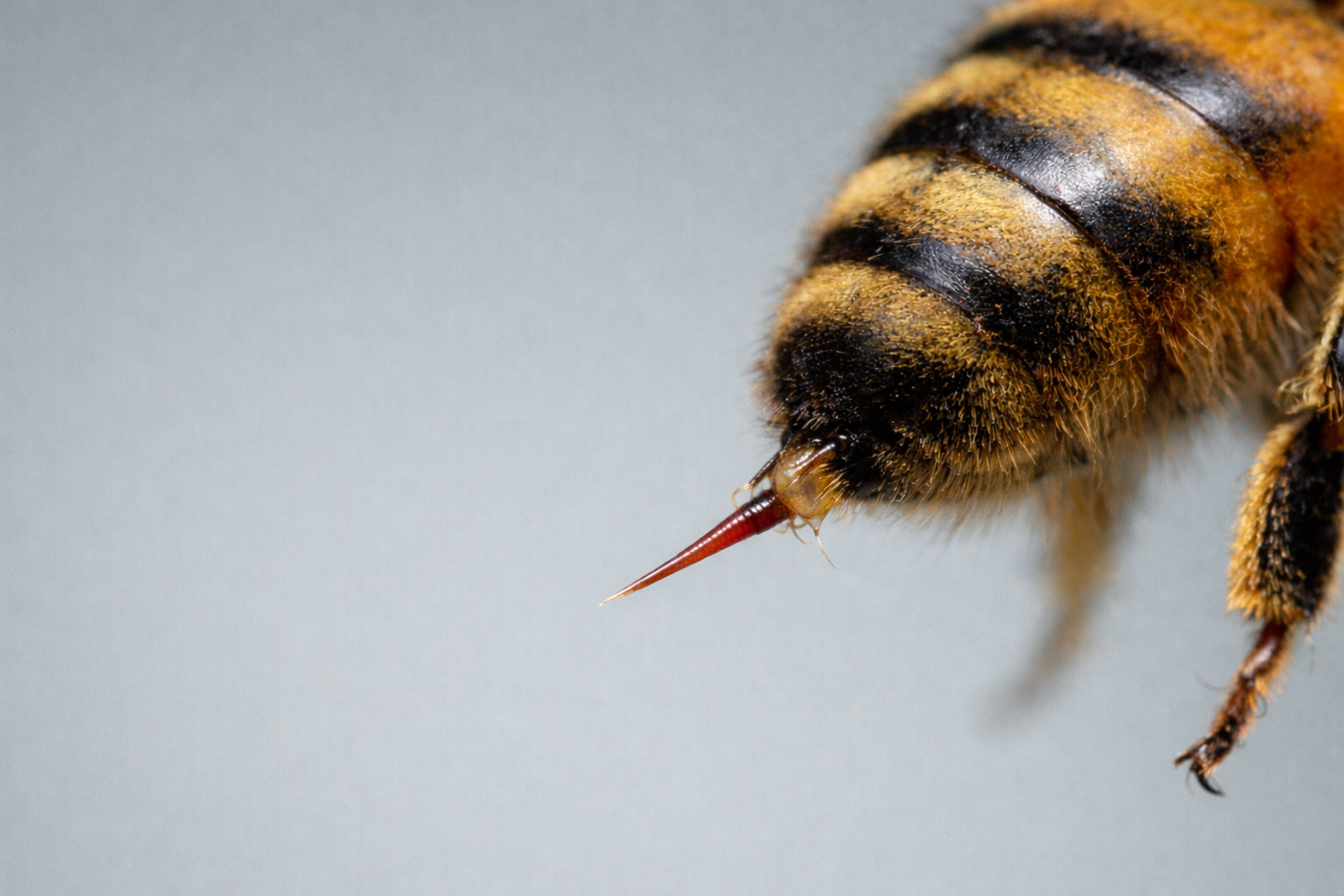
The sting of a honeybee is an evolutionary paradox—a reproductive organ repurposed into a weapon of absolute sacrifice. It represents the ultimate commitment of the superorganism: to defend the collective at the cost of the individual. When a bee strikes, it delivers a “biochemical baptism” so potent that it continues to function even after the bee has departed. This final act is not merely a puncture; it is the deployment of an autonomous injection system, engineered to maximize pain, destroy tissue, and mark the enemy for total annihilation.
To analyze the sting is to examine the “toxic barometer” of the hive, a threshold where the laws of individual survival are discarded in favor of colonial integrity.
🐝 Table of Contents
- 🤺 1. The Barb and the Lancet — Mechanics of Permanent Attachment
- 🧪 2. Apitoxin Biochemistry — The Cytolytic Cocktail
- 💓 3. The Autonomous Pump — Life After the Sting
- 🚩 4. Pheromonal Tagging — The Call to Collective Action
- ✨ A Poetic Reflection
🤺 1. The Barb and the Lancet — Mechanics of Permanent Attachment
The stinging apparatus is composed of three primary parts: a central stylet and two sliding lancets. These lancets are armed with microscopic barbs, designed to grip the elastic skin of mammals.
[Image of the structure of a honeybee stinger with barbs]
- The One-Way Entry: As the bee thrusts, the barbs lock into the tissue. The reciprocal sliding motion of the lancets drives the stinger deeper into the wound, making it impossible to withdraw without fatal trauma to the bee’s internal anatomy.
- Sacrificial Autotomy: This process, known as autotomy, leaves the entire venom apparatus embedded in the predator, a visceral anchor for the continued delivery of toxins.
🧪 2. Apitoxin Biochemistry — The Cytolytic Cocktail
Honeybee venom, or Apitoxin, is a sophisticated chemical weapon composed of enzymes, peptides, and biogenic amines, each with a specific tactical role.
- Melittin: Accounting for 50% of the dry weight, this powerful peptide acts like a biological detergent, tearing holes in cell membranes and causing the immediate sensation of intense burning.
- Phospholipase A2: An enzyme that breaks down phospholipids, facilitating the spread of the venom through the tissue and amplifying the inflammatory response.
- Apamin: A neurotoxin that blocks specific potassium channels, heightening the sensitivity of the nervous system and ensuring the predator remembers the encounter.
💓 3. The Autonomous Pump — Life After the Sting
One of the most remarkable features of the honeybee sting is its autonomy. Once the apparatus is torn from the bee’s abdomen, the attached ganglionic nerves and muscles continue to function.
The rhythmic pulsing of these muscles acts as a miniature pump, driving the stinger deeper and continuously emptying the venom sac into the wound for several minutes. This ensures that even if the bee is swiped away, the chemical assault continues unabated.
🚩 4. Pheromonal Tagging — The Call to Collective Action
The sting is also a beacon. As it is deployed, a release of “Alarm Pheromone” (primarily isoamyl acetate) occurs. This scent, reminiscent of overripe bananas, diffuses rapidly through the air.
Neighboring bees do not see the target; they “smell” the location of the breach. This pheromonal tag overrides individual foraging behavior, triggering a localized mass-aggression response. The first sting is rarely the last; it is the opening chord of a defensive symphony.
✨ A Poetic Reflection
It is the final signature of a life, written by severing one’s own heart to protect the sanctuary.
🐝→ Next Post (Apis 16: The Physiology of the Queen)
🐝← Previous Post (Apis 14: The Chemical Antenna)
🐝→ Back to Series: The Apis Records
コメント