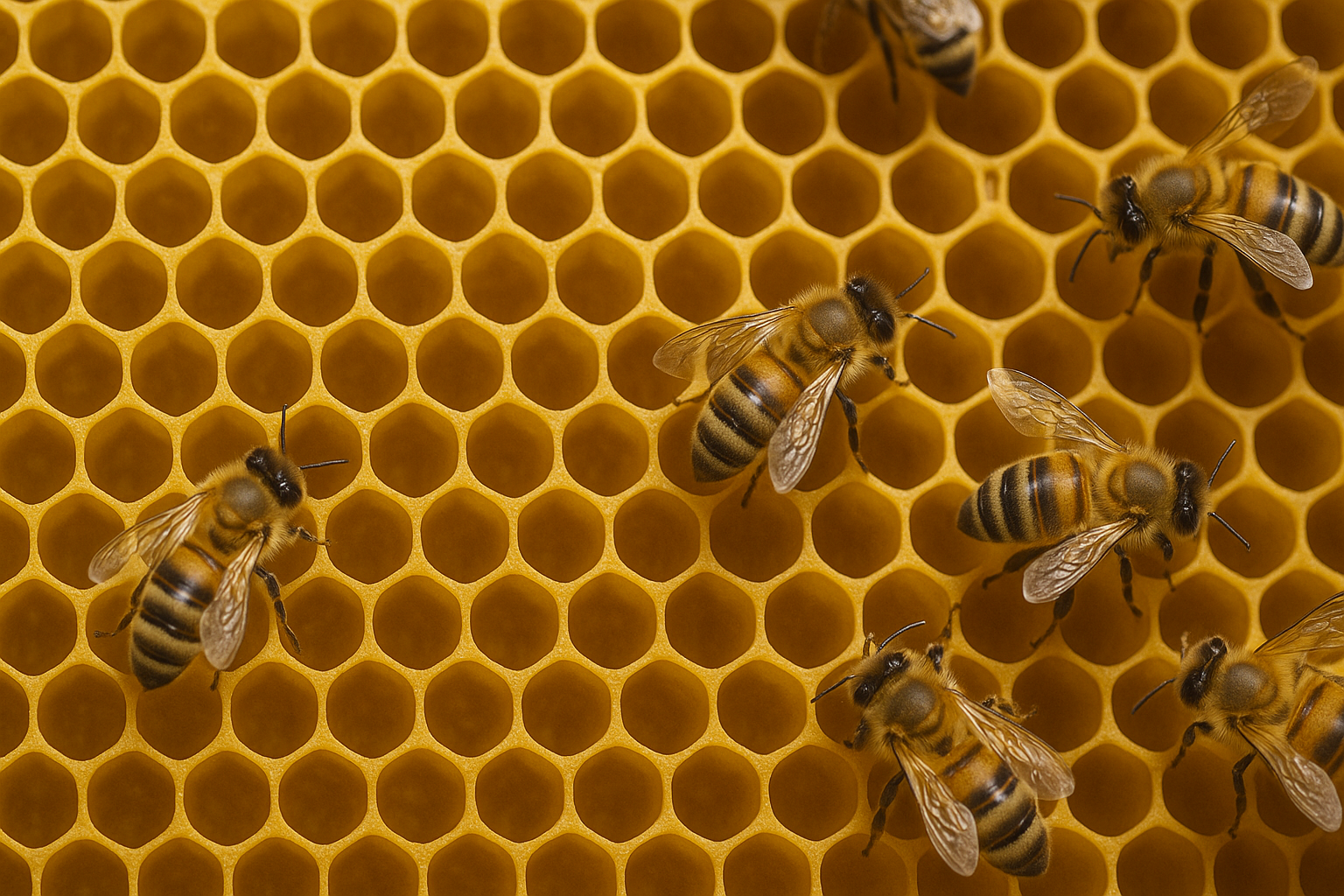
On the vertical wax surface of a pitch-black hive, a scout bee vibrates her body in a frantic “figure-eight” pattern. This “Waggle Dance” is one of the most sophisticated symbolic communication systems discovered in the natural world. In a display of abstract intelligence, the bee compresses the three-dimensional coordinates of a floral resource kilometers away into a two-dimensional code of “angles” and “durations.” Within the hive, these bees function as mathematicians, calculating the invisible sun and transposing space into the dimension of time.
To decode the Waggle Dance is to analyze the “Calculus of the Hive”—a system where biological motion serves as a carrier for complex environmental data.
🐝 Table of Contents
- 📐 1. Solar Transposition — Mapping the Sun to Gravity
- ⏳ 2. The Optical Odometer — How Bees Measure Distance
- 📈 3. Quorum Sensing — The Stochastic Decision-Making Process
- 🌪️ 4. Wind Compensation — Vector Integration in Flight
- ✨ A Poetic Reflection
📐 1. Solar Transposition — Mapping the Sun to Gravity
The most abstract feat of the honeybee brain is the ability to transpose celestial angles into gravitational vectors. In the darkness of the hive, “up” represents the current position of the sun.
- Geometric Translation: If a food source is located 45 degrees to the right of the sun, the scout bee will orient her waggle run 45 degrees to the right of the vertical line of the comb.
- Dynamic Updating: As the sun moves across the sky during the day, the scout bee automatically adjusts the angle of her dance, even if she has remained inside the dark hive for hours, indicating an internal ephemeris (celestial) clock.
⏳ 2. The Optical Odometer — How Bees Measure Distance
Honeybees do not measure distance by wingbeats or time alone, but through “Optical Flow.” As they fly, they gauge how quickly the image of the ground moves across their compound eyes.
- The Cost of Travel: A bee flying through a dense forest perceives more “flow” than a bee flying over a flat desert. The duration of her waggle phase reflects this visual energy expenditure, telling her sisters not just how far the goal is, but how much effort is required to reach it.
- Precision: This visual odometer is so precise that a scout can communicate the location of a single flowering tree in a vast, multi-kilometer landscape.
📈 3. Quorum Sensing — The Stochastic Decision-Making Process
The hive does not follow every dance. It operates as a decentralized, stochastic (probabilistic) computer. Recruits observe multiple dancers and make a collective choice based on the “vigorousness” of the signals.
A scout that has found a high-concentration nectar source will dance for longer and with higher abdominal frequency. This increases the probability of recruiting more followers. Through this quorum sensing, the superorganism ensures that its foraging workforce is always allocated to the highest return-on-investment (ROI) locations, effectively solving complex resource-allocation problems without a central controller.
🌪️ 4. Wind Compensation — Vector Integration in Flight
During the flight to the resource, a bee may encounter crosswinds or head-on resistance. Remarkably, they integrate these environmental variables into their navigation.
By adjusting their flight angle to maintain a consistent optical flow toward the goal, they perform real-time vector calculus. When they return to the hive, the dance they perform reflects the corrected “truth” of the location, compensating for the atmospheric drift experienced by the individual.
✨ A Poetic Reflection
It is the geometry of the sun traced upon the weight of gravity—where, in the deep dark, space is rewritten as a melody of movement.
🐝→ Next Post (Apis 20: Cognitive Cartography)
🐝← Previous Post (Apis 18: The Nurse and the Scout)
🐝→ Back to Series: The Apis Records
コメント