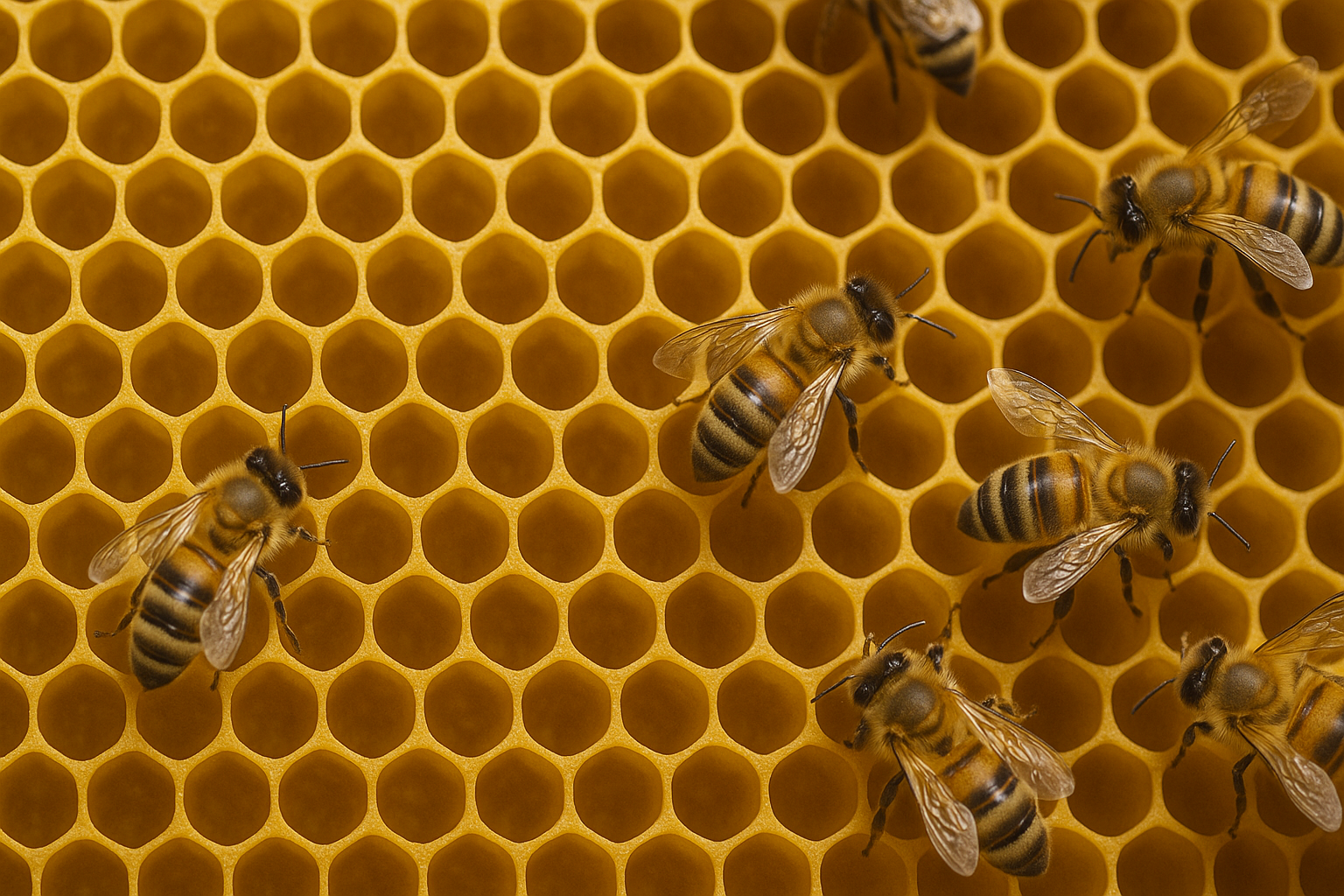
The hexagonal comb constructed by the honeybee is nature’s most profound manifestation of “Sacred Geometry.” Why not circles, or squares? The answer lies in the relentless pursuit of a mathematical optimum: securing maximum storage volume while eliminating structural redundancy. This “Hexagonal Gospel” is not merely an instinctual blueprint, but a masterpiece of self-organization, where biological intent meets the laws of surface tension within a thermal cradle of 35°C.
🐝 Table of Contents
- 📐 1. The Isoperimetric Problem — Mathematical Efficiency of the Hexagon
- ⚗️ 2. The Bio-Plastic — Biochemistry of Wax Secretion
- 🔥 3. Thermal Plasticity — The Role of Body Heat in Construction
- 🌊 4. Surface Tension — From Cylinders to Hexagons
- ✨ A Poetic Reflection
📐 1. The Isoperimetric Problem — Mathematical Efficiency of the Hexagon
Beeswax is an expensive biological commodity. To secrete a single gram of wax, a worker must consume approximately eight grams of honey. This high metabolic cost dictates an architecture of extreme parsimony. In geometry, the hexagon is the most efficient shape for tiling a plane (tessellation) without gaps. Compared to triangles or squares, the hexagon provides the largest area for the shortest perimeter. By adopting this form, the superorganism solves the “isoperimetric problem,” ensuring that every milligram of wax provides the maximum possible storage for larvae and nectar.
⚗️ 2. The Bio-Plastic — Biochemistry of Wax Secretion
The raw material for the hive is produced in four pairs of specialized wax glands located on the ventral side of the worker’s abdomen. These glands secrete liquid wax that hardens into translucent “scales” upon contact with the air. The bee then uses its mandibles to knead these scales, incorporating glandular enzymes that alter the wax’s molecular structure, transforming it into a highly malleable “bio-plastic.” This material is engineered to be rigid enough to bear the weight of kilograms of honey, yet flexible enough to be reshaped by the collective will of the colony.
🔥 3. Thermal Plasticity — The Role of Body Heat in Construction
Construction does not occur in a cold environment. To manipulate the wax, the bees must maintain a precise localized temperature of 33°C to 35°C. Workers huddle together in “living chains” (festooning), their collective metabolism acting as a kiln. At this specific temperature, beeswax reaches a state of high plasticity, allowing for the wall thickness to be refined to a staggering 0.07 millimeters—a precision that rivals industrial manufacturing.
🌊 4. Surface Tension — From Cylinders to Hexagons
Recent thermodynamic analyses suggest that the perfection of the hexagon is a collaborative effort between the bee and the laws of physics. Initial construction often begins as circular cylinders. However, as the collective heat of the bees softens the wax to a semi-liquid state, the force of surface tension intervenes. The intersecting walls of the softened cylinders naturally pull toward each other at 120-degree angles—the path of least resistance. The bee provides the heat and the raw material, but the physics of liquids provides the final geometric “snap” into the hexagonal grid.
✨ A Poetic Reflection
It is a crystal where mathematical dreams are poured into a golden mold by the heat of ten thousand pulses, a moment where life and physics shake hands.
🐝→ Next Post (Apis 22: Thermodynamic Control)
🐝← Previous Post (Apis 20: Cognitive Cartography)
🐝→ Back to Series: The Apis Records


コメント