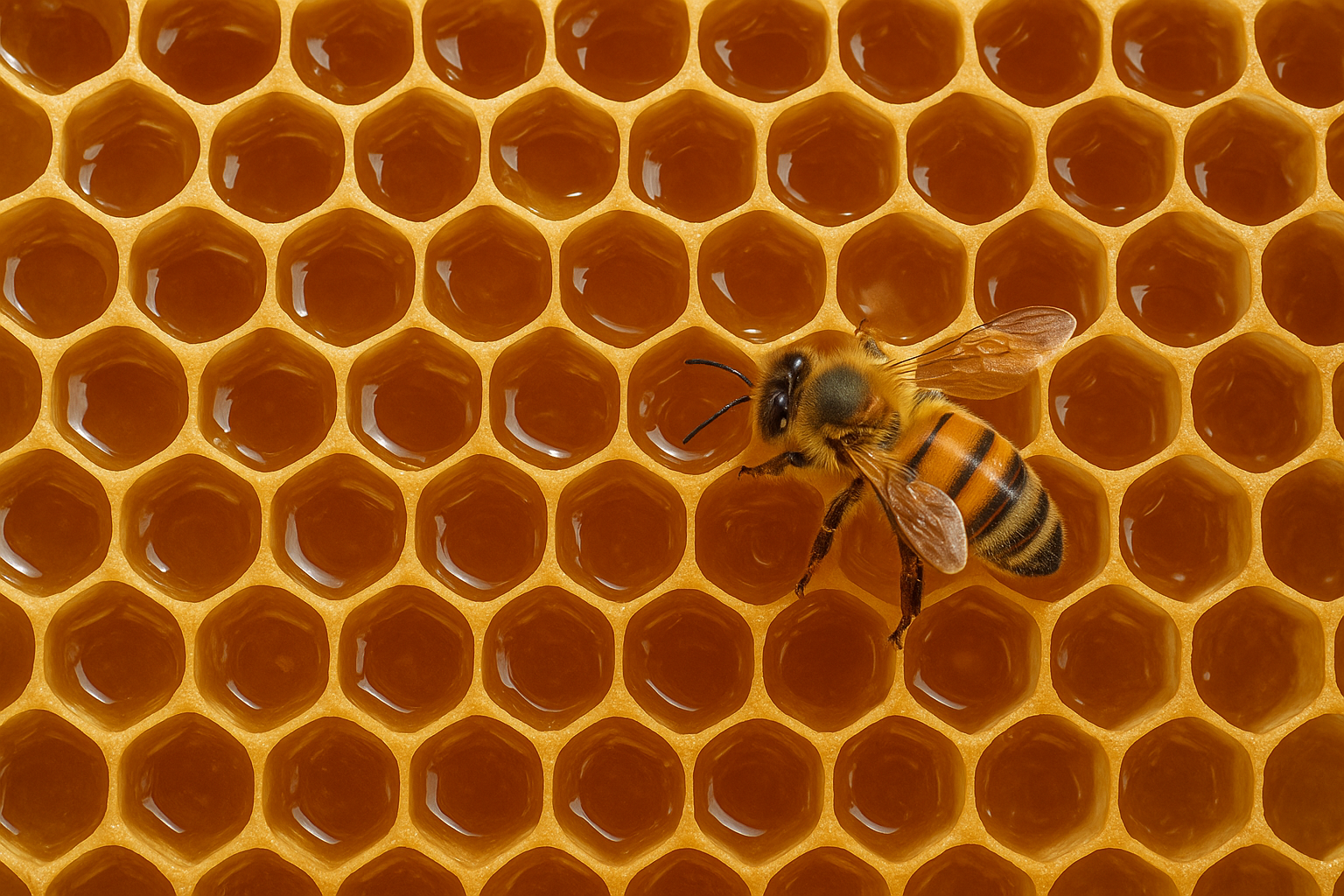
Nectar, in its raw botanical state, is nothing more than a dilute solution of unstable sugars. Its transformation into honey—a high-energy, non-perishable food source—is a sophisticated “biochemical alchemy” conducted within the bee’s body and the hive’s laboratory. This process involves a two-stage metamorphosis: the enzymatic hydrolysis of complex disaccharides into simple monosaccharides, and the physical concentration of the solution to suppress microbial life. The enzyme-laden droplets from the bee’s hypopharyngeal glands rewrite a transient floral gift into a “liquid gold” that can persist for decades.
🐝 Table of Contents
- ⚗️ 1. Invertase Catalysis — The Cleaving of Sucrose
- 🛡️ 2. The Oxidative Defense — Gluconic Acid and $H_2O_2$
- 🌬️ 3. Active Dehydration — Lowering Water Activity ($a_w$)
- 🍯 4. The Final Maturation — Capping and Longevity
- ✨ A Poetic Reflection
⚗️ 1. Invertase Catalysis — The Cleaving of Sucrose
The transformation begins the moment nectar enters the honey stomach (crop) of the forager. The bee introduces invertase (saccharase), an enzyme that attacks the glycosidic bonds of sucrose. This hydrolytic reaction breaks the complex disaccharide into its constituent monosaccharides: glucose and fructose.
- Inversion: This process creates “inverted sugar,” which is significantly more resistant to crystallization and easier for the bee’s metabolism to absorb during the winter months.
- Pre-processing: Even before the bee returns to the hive, the chemical signature of the nectar is already being fundamentally altered by the host’s glandular secretions.
🛡️ 2. The Oxidative Defense — Gluconic Acid and Hydrogen Peroxide
The laboratory of the hive is not just interested in energy density, but in total sterilization. The enzyme glucose oxidase is added to the ripening honey, catalyzing a specific reaction between glucose and oxygen.
- Acidity: This reaction produces gluconic acid, dropping the pH of the honey to between 3.2 and 4.5—an environment too acidic for most pathogenic bacteria.
- Sanitization: A byproduct of this reaction is hydrogen peroxide ($H_2O_2$), providing a potent, slow-release antimicrobial barrier that protects the ripening honey from fermentation while it is still in its high-moisture phase.
🌬️ 3. Active Dehydration — Lowering Water Activity ($a_w$)
Chemical conversion alone is insufficient; physical stabilization is required. Bees must reduce the water content of nectar from approximately 80% to less than 18%. This is achieved through active manipulation and airflow.
House bees engage in a repetitive behavior known as “bubbling,” where they regurgitate a droplet of nectar and hold it between their mandibles, exposing it to the warm, dry air of the hive. Combined with the synchronized fanning of the colony, this facilitates rapid evaporation. Once the water activity ($a_w$) drops below a certain threshold, osmotic pressure becomes so intense that any microbial cell that enters the honey is instantly dehydrated and killed through plasmolysis.
🍯 4. The Final Maturation — Capping and Longevity
Only when the chemistry and moisture levels are perfect do the bees seal the cells with a thin layer of wax. This airtight cap prevents the honey from re-absorbing moisture from the atmosphere (hygroscopy). Inside these sealed vaults, the honey remains in a state of biological stasis—a calorie-dense fuel reserve that represents the distilled labor of thousands of flights and millions of enzymatic reactions.
✨ A Poetic Reflection
It is a silent distillation, where the fleeting sweetness of a flower is rewritten into eternal amber by the pen of an enzyme.
🐝→ Next Post (Apis 24: The Pollen Press)
🐝← Previous Post (Apis 22: Thermodynamic Control)
🐝→ Back to Series: The Apis Records
コメント