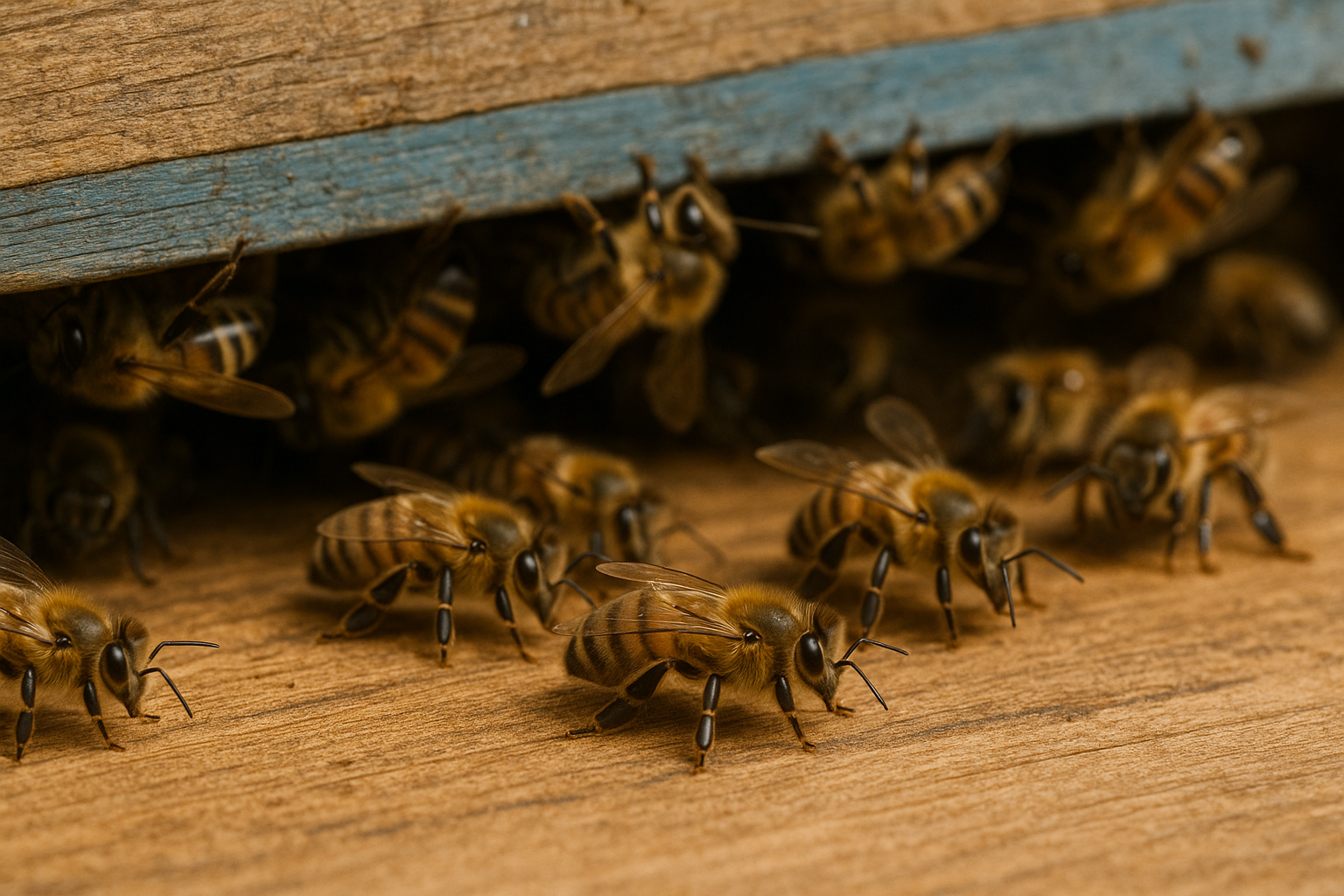
Our profound thirty-episode journey through the world of Apis converges upon a single, inescapable realization: the honeybee is not merely facing extinction; it is undergoing a fundamental transformation. For millennia, the bee has served as a “biological mirror,” reflecting the health and integrity of the landscapes it inhabits. To lose the hum of the hive would be more than the disappearance of a single insect; it would signal the unraveling of the intricate, multi-million-year-old network of interdependence that sustains terrestrial life. Yet, where cutting-edge science intersects with ancient wisdom, the seeds of a new symbiosis are beginning to take root.
🐝 Table of Contents
- 📡 1. The Sentient Hive — From Pollinator to Global Bio-Sensor
- 🌆 2. Urban Resurgence — Anchoring Biodiversity in the Concrete Jungle
- 🚀 3. Beyond Earth — The Honeybee as a Pioneer of Extraterrestrial Life
- 🤝 4. The Superorganism Metaphor — A New Ethic of Stewardship
- ✨ A Poetic Reflection
📡 1. The Sentient Hive — From Pollinator to Global Bio-Sensor
The future of apiculture lies in the transition from passive management to “Bio-Digital Monitoring.” By utilizing AI-driven sensors to analyze vibrational frequencies, thermal flux, and CO2 concentrations within the hive, we are beginning to decode the language of the superorganism in real-time. In this future projection, the honeybee functions as the planet’s premier bio-sensor, providing high-fidelity data on pesticide exposure, floral shifts, and climate instability long before these changes become visible to human eyes.
🌆 2. Urban Resurgence — Anchoring Biodiversity in the Concrete Jungle
As human populations centralize into megacities, the honeybee is becoming the “anchor species” for urban ecology. Rooftop apiaries and community gardens are transforming urban heat islands into corridors of floral diversity. In this new symbiosis, the honeybee acts as a catalyst for human psychological re-connection with nature, moving us away from a paradigm of “exploitation” toward one of “stewardship,” where the health of the city is measured by the activity at the hive entrance.
🚀 3. Beyond Earth — The Honeybee as a Pioneer of Extraterrestrial Life
In the development of Long-duration Life Support Systems (LSS) for lunar and Martian colonies, Apis mellifera is a prime candidate for off-world food production. Their spatial efficiency and unparalleled pollination accuracy make them superior to mechanical alternatives. When humanity eventually leaves its terrestrial cradle, the honeybee will likely be the smallest and most essential pioneer, carrying the “ledger of life” to the stars and ensuring that the first Martian blooms do not go unvisited.
🤝 4. The Superorganism Metaphor — A New Ethic of Stewardship
The “intelligence” of the hive—the subordination of the self for the survival of the whole—offers a profound metaphor for a fragmented modern world. To protect the honeybee is to protect the dignity of the “planetary hive.” This final projection suggests that our survival as a species is inextricably linked to our ability to mimic the bee’s cooperative brilliance. By fostering a diverse, resilient, and interconnected global community, we ensure that the Earth’s ledger remains balanced for generations to come.
✨ A Poetic Reflection
It is a faint hum reaching us from beyond the horizon; to make the flower of tomorrow bloom, we must fly together.
🐝← Previous Post (Apis 29: Hybridization and Resilience)
🐝→ Back to Series: The Apis Records
コメント