To look at a bear is to witness a masterpiece of biological engineering. Their bodies are not designed for the singular purpose of the sprint, like the cheetah, nor for pure arboreal life like the primate. Instead, a bear’s anatomy is a multi-tool of the natural world—capable of crushing power, surprising agility, and delicate precision.
From the unique structure of their paws to the specialized density of their bones, every element of a bear’s frame is optimized for a life of “versatile dominance.” They are built to endure, to climb, to dig, and to stand tall when the situation demands it.
🐻 Table of Contents
- 🦴 1. The Skeletal Frame — The Power of the Plantigrade
- 🐾 2. The Forepaw — An Instrument of Precision and Power
- 🦷 3. Dentition and Cranial Strength — The Generalist’s Bite
- 💪 4. Muscular Architecture — Why Bears Never Tire
- 🐾 A Poetic Reflection
🦴 1. The Skeletal Frame — The Power of the Plantigrade
Unlike most carnivores that walk on their toes (digitigrade), bears are plantigrade, meaning they walk with their heels flat on the ground—much like humans. This skeletal choice dictates their entire lifestyle.
- Bipedal Stability: The broad base of the hind feet allows bears to stand upright with remarkable balance, a position used for intimidation or better visibility.
- Heavy-Duty Bones: Their bones are exceptionally dense to support a massive muscular load, particularly in the humerus and femur.
- Lack of Clavicle: Like many large mammals, bears lack a collarbone, allowing their shoulder blades a greater range of motion for climbing and powerful swiping.
🐾 2. The Forepaw — An Instrument of Precision and Power
The “hand” of a bear is one of nature’s most effective tools. Each paw is equipped with five non-retractable claws that serve as both crampons and excavators.
- Digging and Flipping: The strength of their forelimbs allows them to flip boulders weighing hundreds of pounds to reach insects beneath.
- Climbing: Even the heaviest Grizzly can climb with surprising speed, using their claws to “hook” into the bark.
- The “Pseudo-Thumb”: In the Giant Panda, an enlarged sesamoid bone functions as a sixth digit to grip bamboo, a peak example of anatomical specialization.
🦷 3. Dentition and Cranial Strength — The Generalist’s Bite
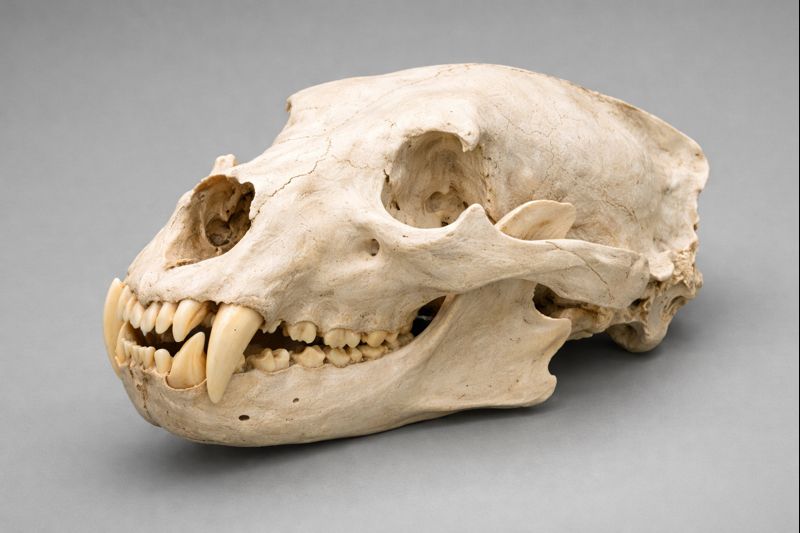
A bear’s skull is built for massive bite force, but its teeth tell the story of a diverse diet. They possess the fangs of a predator and the grinders of a gatherer.
- Canines: Long and robust for defense and capturing prey.
- Post-Canine Gap (Diastema): Often present, allowing for efficient manipulation of plant matter.
- Bunodont Molars: Unlike the shearing teeth of cats, bear molars are rounded and flat, perfect for crushing nuts, tubers, and vegetation.
💪 4. Muscular Architecture — Why Bears Never Tire
The iconic “hump” on a Grizzly bear is not fat; it is a massive bundle of muscle attached to the vertebrae, specifically designed to power the forelimbs for digging and striking.
- Fast-Twitch vs. Slow-Twitch: Bears possess a balanced ratio of muscle fibers, allowing for explosive bursts of speed (up to 35 mph) while maintaining the endurance needed for long-distance foraging.
- Hypertrophy without Movement: During hibernation, bears possess a unique physiological ability to prevent muscle atrophy, a feat currently being studied for human medical applications.
🐾 A Poetic Reflection
Within the heavy arch of a bear’s shoulder lies the strength to move mountains and the grace to pluck a single leaf.
🐻→ Next Post (Bear 4: A World of Scents)
🐻← Previous Post (Bear 2: Evolution and Lineage)
🐻🏠 Series Overview: Bears


コメント