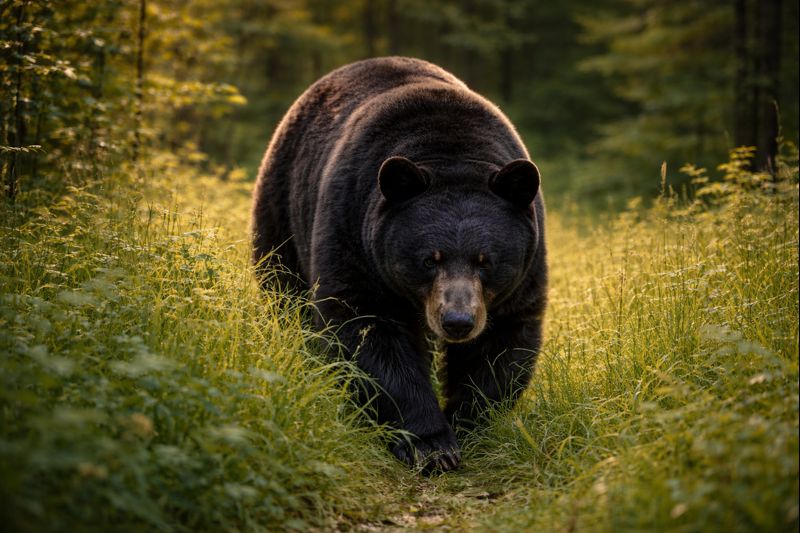
For a bear, the world is not primarily defined by what is seen or heard, but by what is smelled. While humans rely on vision to navigate their surroundings, a bear “sees” through a complex, invisible tapestry of odors carried by the wind. They live in a sensory dimension far beyond our comprehension.
Their sense of smell is not merely for finding food; it is a sophisticated biological radar that detects danger, identifies kin, and reads the history of the landscape. To a bear, the breeze is a library of information, and the air is thick with stories waiting to be told.
🐻 Table of Contents
- 👃 1. The Anatomy of an Apex Nose — A Biological Radar
- 🌬️ 2. Distance and Precision — Tracking the Invisible
- 🧬 3. Olfactory Intelligence — Memory and Identification
- 🐾 4. Navigating a Scent-Based World — Survival Strategies
- 🐾 A Poetic Reflection
👃 1. The Anatomy of an Apex Nose — A Biological Radar
The internal structure of a bear’s nose is a masterpiece of specialized evolution, designed to capture and process even the most microscopic scent molecules.
- Nasal Mucosa Surface Area: The internal area of a bear’s snout is lined with hundreds of millions of scent receptors. In some species, this surface area is 100 times greater than that of a human.
- Ethmoturbinals: Complex, honeycomb-like bone structures within the nasal cavity that maximize the contact between air and olfactory neurons.
- The Olfactory Bulb: The part of the brain dedicated to processing smells is proportionally much larger in bears than in any other land mammal, allowing for high-definition “scent-mapping.”
🌬️ 2. Distance and Precision — Tracking the Invisible
The sheer range of a bear’s olfactory ability is staggering, often outperforming even the most highly trained search-and-rescue dogs.
- Extreme Range: Polar bears have been documented tracking the scent of a seal through solid ice from over 20 miles (32 km) away.
- Directional Sensitivity: By utilizing their large, mobile nostrils, bears can determine the exact direction of a scent source by comparing the concentration of molecules between each nostril.
- Underwater Scenting: While they cannot smell underwater, they can catch the “scent trail” of aquatic prey the moment it breaks the surface or clings to the ice.
🧬 3. Olfactory Intelligence — Memory and Identification
For a bear, scent is a form of social and historical data. It is how they communicate without ever making a sound.
- Individual Signatures: Bears can identify specific individuals, their reproductive status, and even their stress levels simply by smelling a “rub tree” or a footprint.
- Temporal Depth: They can distinguish between a “fresh” scent and one that is several days old, allowing them to track the movements of others through time.
- Food Mapping: A bear can memorize the scent profile of a ripening berry patch miles away and navigate directly to it when the timing is perfect.
🐾 4. Navigating a Scent-Based World — Survival Strategies
Every movement a bear makes is calculated based on the wind. They are masters of olfactory positioning.
- Upwind Approach: Bears almost always travel upwind when searching for food to ensure they catch the scent before the prey detects them.
- Scent Marking: By rubbing their backs against trees or stomping scent into the ground with pedal glands, they leave “chemical messages” for other bears, defining territories and avoiding unnecessary conflict.
- Human Interaction: Most “surprise” encounters occur when the wind is blowing away from the bear, preventing them from smelling a human’s approach.
🐾 A Poetic Reflection
The bear walks through a world of ghosts, following trails of memory that the wind has whispered into the hollows of its mind.
🐻→ Next Post (Bear 5: The Opportunistic Generalist)
🐻← Previous Post (Bear 3: Anatomical Engineering)
🐻🏠 Series Overview: Bears

コメント