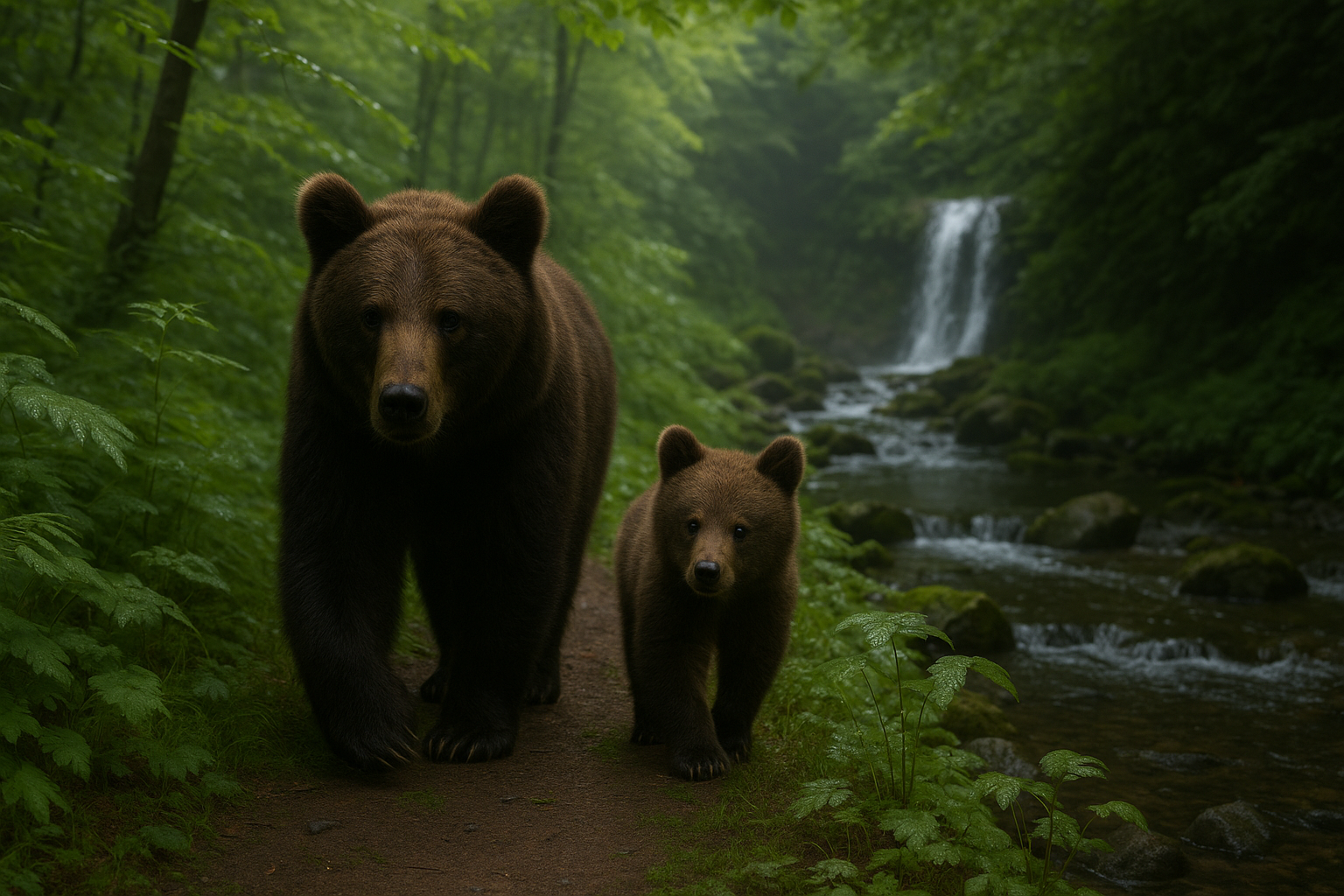
The survival of the bear species rests almost entirely upon the shoulders of the solitary female. Unlike many mammals, male bears play no role in the upbringing of their offspring; in fact, they can often be a threat. A mother bear’s journey is one of extreme sacrifice, characterized by years of constant vigilance and a physiological feat that begins in the depths of winter.
From the mysterious biological clock of “delayed implantation” to the miraculous nursing that occurs during the starvation of hibernation, the process of raising a cub is a masterclass in maternal endurance. It is a slow, high-stakes investment that defines the population dynamics of the wild.
🐻 Table of Contents
- 🧬 1. Delayed Implantation — The Strategic Biological Clock
- ❄️ 2. Birth in the Den — The Mid-Winter Miracle
- 🐾 3. The Apprenticeship — Years of Learning to Survive
- ⚔️ 4. Protection and Infanticide — The Mother’s Constant War
- 🐾 A Poetic Reflection
🧬 1. Delayed Implantation — The Strategic Biological Clock
Bears utilize a fascinating reproductive strategy known as **Delayed Implantation** (embryonic diapause). This ensures that cubs are only born if the mother is healthy enough to support them.
- The Summer Mating: While bears mate in early summer, the fertilized egg does not immediately attach to the uterine wall. It remains in a state of suspended animation for months.
- The Threshold of Fat: The egg will only implant in late autumn if the mother has gained enough body fat. If her fat reserves are too low—meaning she might not survive the winter—the body naturally absorbs the embryo, preventing a futile birth.
- Synchronized Birth: This mechanism allows all cubs in a region to be born at roughly the same time in mid-winter, regardless of when their parents mated.
❄️ 2. Birth in the Den — The Mid-Winter Miracle
In the darkest part of the winter (usually January), while the mother is in a state of torpor, she gives birth. The cubs are born in a remarkably underdeveloped state.
- Fragile Beginnings: At birth, a bear cub is roughly the size of a squirrel, hairless, and blind. They weigh less than 1% of their mother’s body mass.
- The Fasting Nurse: For the next three months, the mother provides highly concentrated, fat-rich milk without eating, drinking, or excreting. She literally converts her own body fat into the lifeblood of her cubs.
- Thermoregulation: The cubs survive the freezing temperatures by huddling in the thick fur of their mother’s underbelly, sheltered by the insulated walls of the den.
🐾 3. The Apprenticeship — Years of Learning to Survive
When the family finally emerges from the den in spring, the true education begins. A bear cub’s survival is not based on instinct alone, but on a rigorous multi-year curriculum.
- Learning the Map: Cubs follow their mother for 1.5 to 3.5 years, memorizing the locations of berry patches, salmon runs, and safe travel corridors.
- Dietary Training: They learn which plants are edible, how to scavenge without getting injured, and the complex techniques of hunting or fishing.
- Social Boundaries: Mothers teach cubs how to react to other bears—when to stand their ground and when to flee.
⚔️ 4. Protection and Infanticide — The Mother’s Constant War
One of the darkest realities of bear biology is the threat posed by adult males. A mother bear is often in a state of defensive war.
- The Threat of Males: Strange males may attempt to kill cubs to bring the female back into estrus (mating readiness). This is a primary driver of cub mortality.
- Fierce Defense: The legendary “Mama Bear” aggression is a necessary survival trait. A female will fight an animal twice her size to protect her lineage.
- The Family Breakup: Eventually, the mother will aggressively drive her grown cubs away. This “emancipation” is necessary for the cubs to establish their own territories and for the mother to breed again.
🐾 A Poetic Reflection
Within the frozen silence of the den, a mother weaves her own life into the breath of her children, gambling her flesh against the coming of the sun.
🐻→ Next Post (Bear 11: The Science of Hibernation)
🐻← Previous Post (Bear 9: The Language of Ears and Eyes)
🐻🏠 Series Overview: Bears

コメント