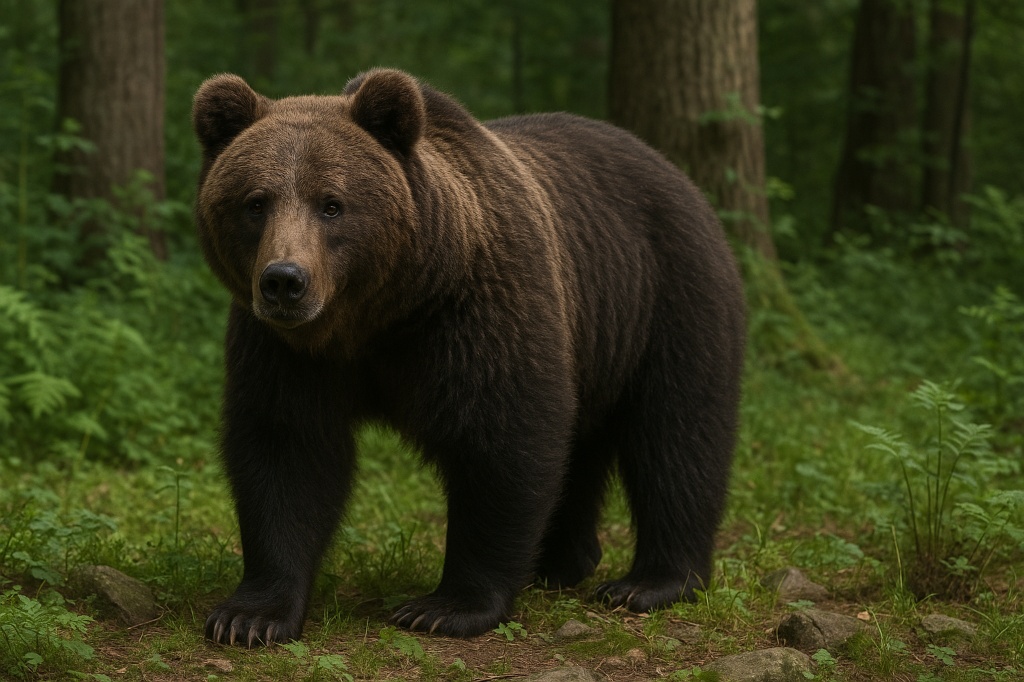
| Basic Species Profile | |
|---|---|
| Scientific Name | Ursus arctos |
| Common Names | Brown Bear, Grizzly (Inland), Kodiak Bear (Insular) |
| Range & Habitat | Holarctic distribution; from Arctic tundra and alpine meadows to dense boreal forests and coastal estuaries. |
| Mass (Adult Male) | 180 kg – 680 kg (Up to 800 kg for Kodiak) |
| Bite Force | Approx. 1,160 – 1,200 PSI |
| Conservation Status | Least Concern (IUCN), though many local populations are endangered. |
The Brown Bear is a living monument to the raw power of nature. Covering a vast longitudinal range across North America, Europe, and Asia, they are the most widely distributed bear species on Earth. Yet, the term “Brown Bear” conceals an incredible diversity—from the high-altitude, lean Grizzlies of the Rockies to the massive, salmon-fed giants of Kodiak Island.
In this profile, we examine the sophisticated biology and diverse domains of Ursus arctos. They are masters of caloric intake, geological engineers of the mountains, and a species whose survival is inextricably linked to the integrity of the wild landscapes they patrol.
🐻 Table of Contents
- 🌍 1. The Global Footprint — A Holarctic Domain
- 🧬 2. Subspecies and Variations — Grizzly vs. Coastal Giants
- 🦴 3. The Grizzly Hump — A Biomechanical Advantage
- 🍣 4. The Salmon Pulse — Driving the Growth of Titans
- ⚖️ 5. Conservation Dilemmas — Isolation of the Great Bear
- 🐾 A Poetic Reflection
🌍 1. The Global Footprint — A Holarctic Domain
The Brown Bear possesses a “Holarctic” distribution, meaning it spans the northern latitudes of both the Eastern and Western Hemispheres. Their choice of habitat is governed by two factors: food availability and denning security.
- Eurasian Range: From the scattered populations in the Pyrenees and Apennines to the vast, contiguous forests of Russia (Siberia) and the Scandinavian peninsula.
- North American Range: Primarily found in Alaska, Western Canada, and isolated “islands” of habitat in the Northwestern United States (Wyoming, Montana, Idaho, Washington).
- Habitat Types: They are highly adaptable, occupying open prairies, river valleys, alpine meadows, and dense coniferous forests. Unlike Black bears, they prefer more open environments where their size and strength offer an advantage.
🧬 2. Subspecies and Variations — Grizzly vs. Coastal Giants
While all belong to the same species, the environmental conditions of their specific habitats have created massive differences in morphology.
- The Grizzly (U. a. horribilis): Inland populations that face shorter growing seasons. They are typically smaller and more aggressive, with longer claws adapted for digging roots in hard soil.
- The Kodiak Bear (U. a. middendorffi): Confined to the Kodiak Archipelago in Alaska, these are the largest bears in the world, sustained by an incredible abundance of marine protein.
🦴 3. The Grizzly Hump — A Biomechanical Advantage
The most distinctive feature of the Brown Bear is the prominent hump of muscle between their shoulder blades.
- Powerful Excavation: This muscle powers the forelimbs with immense torque, allowing the bear to excavate entire hillsides in search of ground squirrels or nutrient-rich roots.
- Strike Force: This muscle group allows for a swiping force capable of breaking the spine of an adult elk in a single blow.
🍣 4. The Salmon Pulse — Driving the Growth of Titans
The relationship between coastal Brown bears and the salmon run is one of the most significant energy transfers in the natural world.
- Marine-Derived Nitrogen: By carrying carcasses into the woods, bears distribute marine nitrogen into the terrestrial soil, fertilizing the trees of the coastal rainforests.
- Social Tolerance: While normally solitary, the abundance of salmon at specific river points forces bears into high-density gatherings where complex social hierarchies minimize conflict.
⚖️ 5. Conservation Dilemmas — Isolation of the Great Bear
Despite their “Least Concern” global status, the Brown Bear is vanishing from much of its historic range due to habitat fragmentation.
- Genetic Bottlenecks: Small, isolated populations are prone to inbreeding. Modern conservation focuses on “corridors” that allow bears to travel between protected areas.
- The Human-Wildlife Interface: As humans build deeper into bear country, conflict is inevitable. Successful management relies on “bear-proofing” human activities rather than removing the bears.
🐾 A Poetic Reflection
The Brown Bear is the heavy pulse of the mountain, a shadow that reminds us the world was not made for us alone.
🐻→ Next Post (Bear 14: The American Black Bear)
🐻← Previous Post (Bear 12: Interspecific Dynamics)
🐻🏠 Series Overview: Bears
コメント