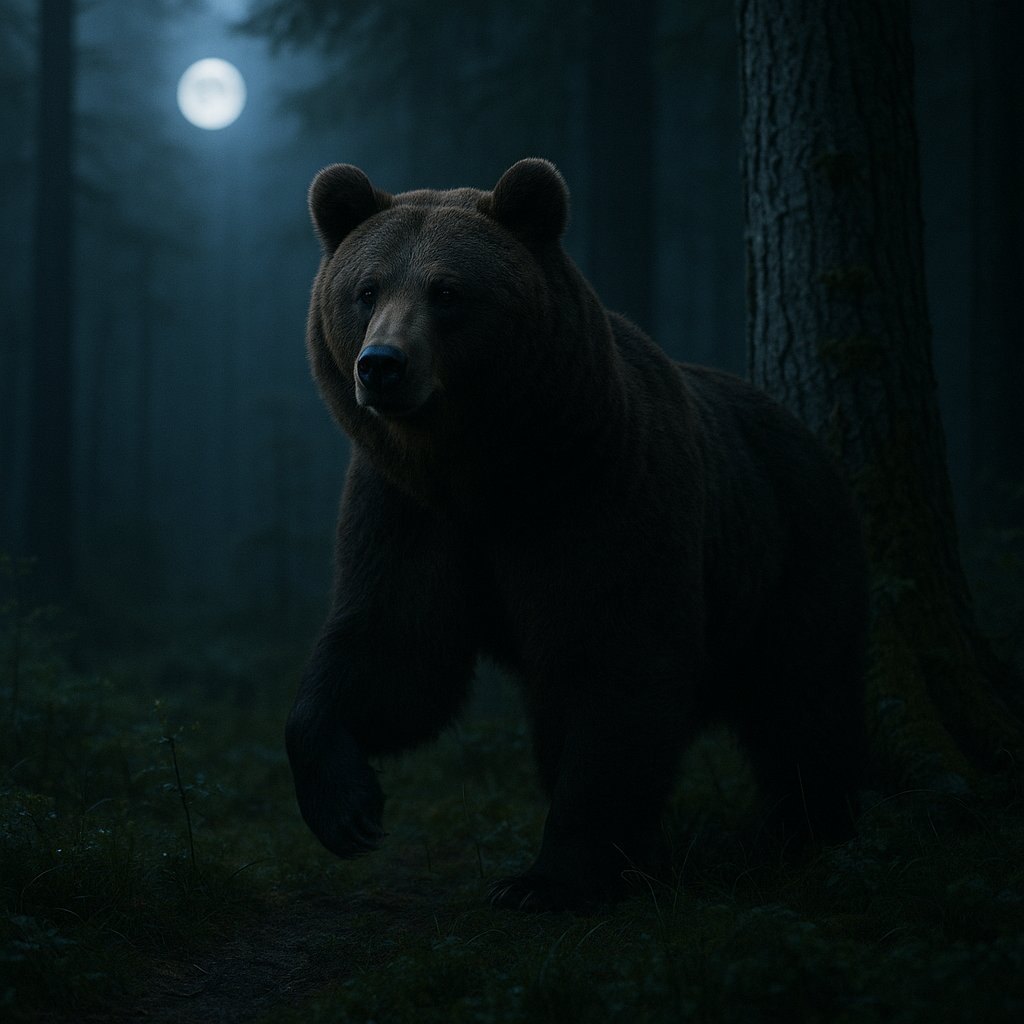
In the Western imagination, the bear has undergone a more radical transformation than perhaps any other creature. Once the undisputed “King of Animals” in Northern Europe, the bear was eventually dethroned by the lion—a shift that reflected the changing political and religious landscapes of the Middle Ages. Yet, even as the bear was tamed in heraldry and nursery rhymes, its celestial presence remained etched into the very sky we navigate by.
This chapter explores the duality of the bear in Western lore: the fierce berserker of the Norse sagas, the tragic nymph of Greek tragedy, and the cuddly companion of the modern era. It is a journey from the heart of the dark forest to the warmth of the hearth.
🐻 Table of Contents
- ✨ 1. The Celestial Bear — Callisto and the Ursa Constellations
- ⚔️ 2. The Berserker Spirit — Norse Valor and the Bear-Shirt
- 👑 3. The Dethroned King — From Medieval Rivalry to Heraldry
- 🧸 4. The Teddy Bear Revolution — The Softening of a Titan
- 🐾 A Poetic Reflection
✨ 1. The Celestial Bear — Callisto and the Ursa Constellations
In the classical world, the bear was elevated to the heavens through one of Greek mythology’s most enduring tragedies.
- Callisto and Arcas: The nymph Callisto, transformed into a bear by the jealousy of Hera, was nearly killed by her own son, Arcas. To save them, Zeus placed them both in the sky as Ursa Major (the Great Bear) and Ursa Minor (the Little Bear).
- The Unsetting Stars: Because these constellations are circumpolar in the Northern Hemisphere, they never “touch the sea” (set below the horizon). This eternal presence made the bear the ultimate guide for sailors and travelers for millennia.
⚔️ 2. The Berserker Spirit — Norse Valor and the Bear-Shirt
For the Germanic and Norse tribes, the bear was the pinnacle of warrior strength. It was not just an animal to be hunted, but a spirit to be inhabited.
- The Berserkers: The word “Berserker” literally translates to “bear-shirt” (ber-serkr). These were elite warriors who entered a trance-like fury in battle, believed to be possessed by the spirit of the bear. They were said to be immune to fire and iron.
- Beowulf: Even the name of the great epic hero Beowulf is often interpreted as a “kenning” (metaphor) for the bear: the Bee-Wolf—the creature that raids the bees for honey.
👑 3. The Dethroned King — From Medieval Rivalry to Heraldry
Before the lion was imported as a symbol of Christian royalty, the bear was the sovereign of the European woods. The Church, however, sought to diminish the “pagan” worship of the bear.
- The Shift of Power: Through the Middle Ages, the bear was systematically re-characterized in fables as clumsy or gluttonous (the origin of “Bruin” the bear), while the lion was promoted as the noble king.
- Heraldic Resilience: Despite this, the bear remained a powerful symbol in heraldry. It is the namesake and symbol of Berlin and Bern, representing a grounded, indestructible strength that a mere lion could not replace.
🧸 4. The Teddy Bear Revolution — The Softening of a Titan
The most drastic shift in the bear’s image occurred at the dawn of the 20th century, transforming a feared predator into a symbol of childhood comfort.
- The Roosevelt Connection: In 1902, President Theodore “Teddy” Roosevelt refused to shoot a tethered black bear during a hunt. A political cartoon of the event inspired the creation of the “Teddy Bear.”
- The Archetype of Safety: Within a single generation, the bear moved from the outskirts of civilization to the center of the nursery. This “cuteness” (neoteny) has fundamentally altered how modern humans perceive bear conservation—often prioritizing emotion over ecological reality.
🐾 A Poetic Reflection
The bear is the only king who stepped down from his throne in the woods to watch over our sleep from the stars and the pillow.
🐻→ Next Post (Bear 24: Keystone of the Ecosystem)


コメント