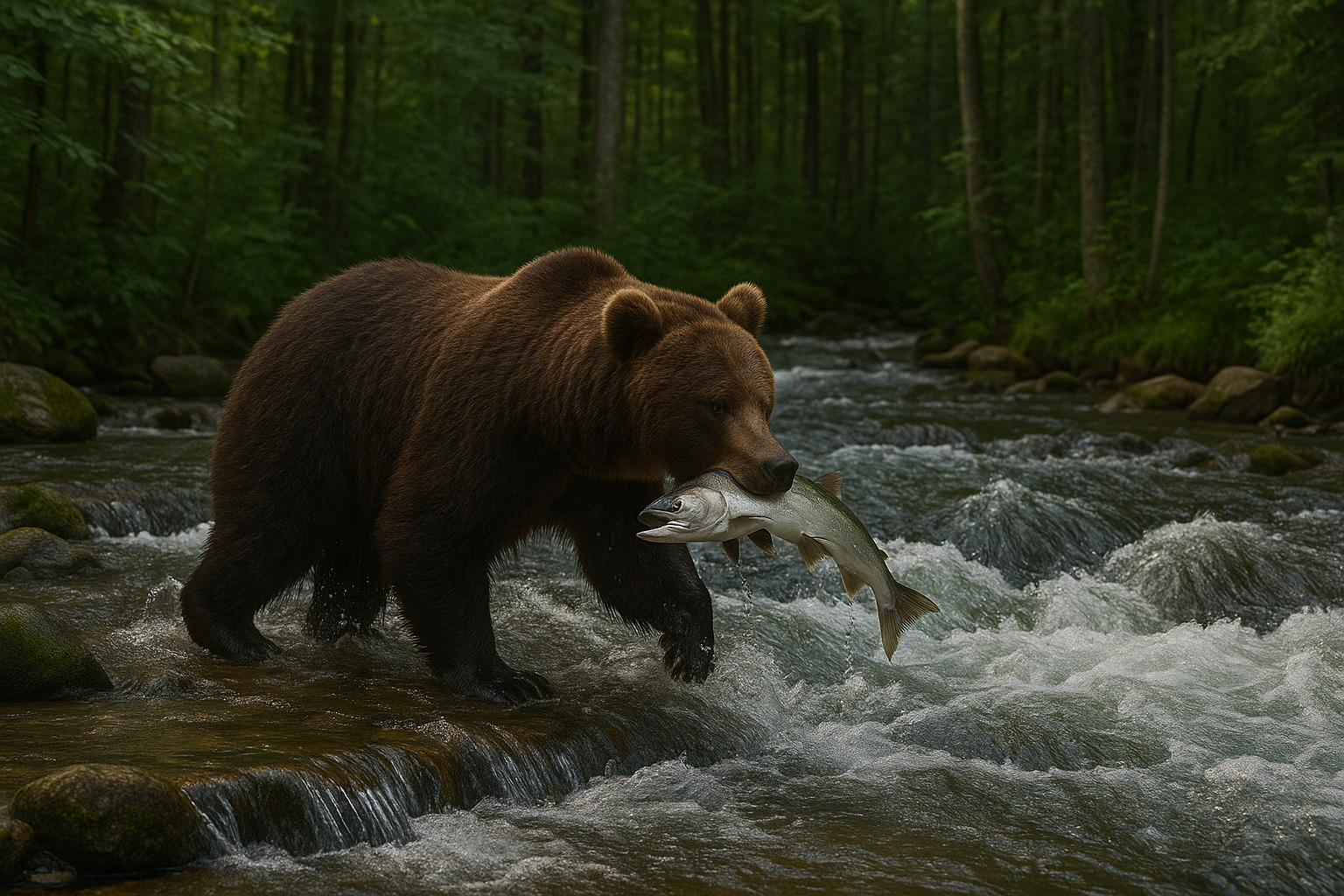
Every autumn, a miraculous transformation occurs in the temperate rainforests of the North Pacific. Millions of salmon return from the open ocean to their natal streams to spawn and die. This is the “Salmon Pulse,” a massive influx of marine energy into a terrestrial system. At the center of this transition is the bear. Without the bear, the ocean’s bounty would largely remain trapped in the riverbeds; with the bear, it becomes the very fabric of the forest itself.
This is not just a story of predator and prey. It is a story of biological alchemy, where marine nitrogen—forged in the deep sea—is transformed into the needles of ancient cedars and the song of forest birds through the mediation of the bear. This chapter explores the “Salmon-Forest Cycle,” a system that defines the health of the entire Pacific Rim.
🐻 Table of Contents
- 🌊 1. Marine Wealth — The Salmon as an Energy Packet
- 🍣 2. Selective Foraging — The Art of High-Fat Consumption
- 🌲 3. The Isotope Trail — How Trees “Eat” Fish
- 🦅 4. The Scavenger Banquet — Feeding the Forest Community
- 🐾 A Poetic Reflection
🌊 1. Marine Wealth — The Salmon as an Energy Packet
Salmon spend years in the ocean accumulating nutrients—specifically nitrogen and phosphorus—that are rare in the leached soils of the rainy coastal forests. When they return to the rivers, they are essentially concentrated “energy packets” of the sea.
- Nutrient Upstreaming: Gravity usually moves nutrients from the land to the sea. The salmon run is one of the few natural processes that moves nutrients “uphill” against gravity.
- Synchronized Timing: Bears have evolved to time their hyperphagia (the period of intense eating before hibernation) precisely with the arrival of the salmon, maximizing their weight gain in a matter of weeks.
🍣 2. Selective Foraging — The Art of High-Fat Consumption
Bears are not just eating fish; they are practicing a sophisticated form of nutritional optimization. When salmon are abundant, bears become “high-grading” specialists.
- Targeting the Best: Bears often eat only the brains, the skin, and the roe (eggs)—the parts highest in fat and omega-3 fatty acids—discarding the leaner muscle.
- The Forest Transfer: To avoid competition or to eat in peace, bears often carry their catch up to 100 meters away from the river into the dense brush. This behavioral trait is the literal engine of the forest’s growth.
🌲 3. The Isotope Trail — How Trees “Eat” Fish
Modern science has confirmed the depth of this connection through stable isotope analysis. By looking for Nitrogen-15 (a signature of marine life) in terrestrial plants, researchers have mapped the bear’s influence.
- The Sitka Spruce Connection: Trees growing near salmon-bearing streams have been found to contain significant amounts of marine-derived nitrogen in their rings. In some areas, up to 50% of the nitrogen in the trees comes from the sea.
- Accelerated Growth: Trees with access to this “bear-distributed fertilizer” can grow up to three times faster than those without, creating the massive, ancient canopies that characterize the Pacific Northwest.
🦅 4. The Scavenger Banquet — Feeding the Forest Community
The “messy” eating habits of the bear create a secondary ecosystem of survival for hundreds of other species.
- Feeding the Multitude: The discarded salmon carcasses are a lifeline for eagles, ravens, gulls, and even small mammals like martens.
- Invertebrate Boom: Blowflies and beetles lay eggs in the remains, creating a massive pulse of larvae that feeds songbirds and amphibians, spreading the sea’s energy even further through the food web.
🐾 A Poetic Reflection
In every needle of the towering pine and every beat of the eagle’s wing, there is a silver fragment of a salmon that a bear once carried into the dark of the woods.
🐻→ Next Post (Bear 26: Forensic Tracking)
コメント