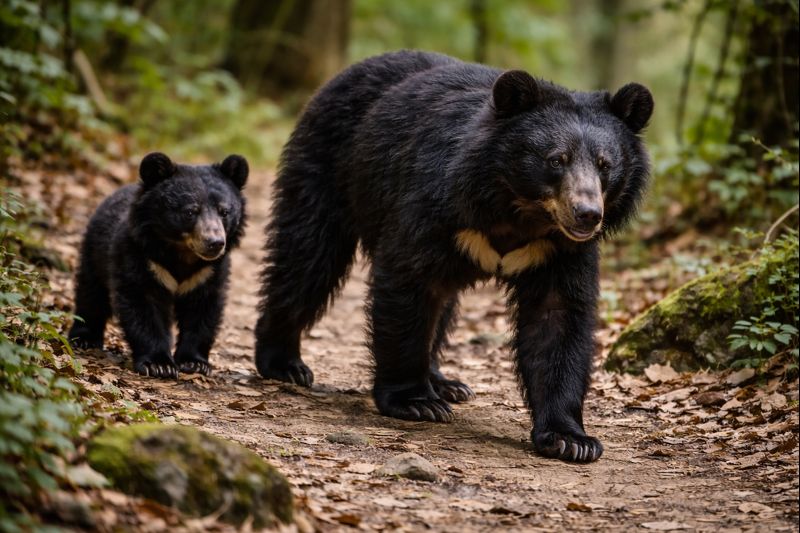
For hundreds of thousands of years, the reproductive boundaries between bear species were maintained by geography and climate. High Arctic ice kept Polar bears apart from the mountain-dwelling Brown bears. However, as the planet warms at an unprecedented rate, these ancient barriers are dissolving. The result is a biological phenomenon that is both fascinating and troubling: the rise of the hybrids.
Hybridization is not just a scientific curiosity; it is a sign of a world in flux. When two distinct evolutionary paths collide, they create a “genetic bridge” that can either lead to a new form of resilience or the slow erasure of a specialized species. In this chapter, we explore the science behind the “Pizzly” and what it tells us about the future of the family Ursidae.
🐻 Table of Contents
- 🧊 1. The Pizzly Phenomenon — When Polar Meets Brown
- 🧬 2. Genetic Compatibility — Why Bears Can Hybridize
- 🌡️ 3. Climate Drivers — The Overlapping Range
- ⚖️ 4. Evolutionary Dilemma — Resilience or Extinction?
- 🐾 A Poetic Reflection
🧊 1. The Pizzly Phenomenon — When Polar Meets Brown
In 2006, a hunter in the Canadian Arctic shot a bear that looked unlike any seen before: it had white fur but long claws, a humped back, and brown patches. DNA testing confirmed it was a “Pizzly” (or Grolar bear)—the offspring of a male Grizzly and a female Polar bear.
- Intermediate Traits: Hybrids often display a mix of parental characteristics. They may have the swimming-optimized neck of a Polar bear but the powerful digging claws of a Grizzly.
- Fertility: Unlike many hybrids in the animal kingdom (such as mules), bear hybrids are often fertile, meaning they can backcross with either parent species, potentially leading to “genetic swamping.”
- Behavioral Mismatch: A major challenge for hybrids is their lifestyle. They may not be as efficient at hunting seals on ice as a Polar bear, nor as adept at foraging for berries as a Grizzly, leaving them in an ecological “no-man’s-land.”
🧬 2. Genetic Compatibility — Why Bears Can Hybridize
The ability to hybridize is rooted in the relatively recent evolutionary history of the bear family.
- Recent Divergence: Polar bears and Brown bears diverged from a common ancestor roughly 400,000 to 600,000 years ago. In evolutionary terms, this is a very short time, meaning their DNA remains compatible enough to produce viable offspring.
- Ancient Precedents: DNA analysis of modern bears shows that hybridization has happened naturally throughout history during previous interglacial periods. We carry the proof in the genomes of certain Brown bear populations that contain ancient Polar bear DNA.
🌡️ 3. Climate Drivers — The Overlapping Range
Hybridization is a direct consequence of “range shifting” caused by the warming Arctic.
- The Northward March: As the interior becomes warmer, Grizzlies are pushing further north into territories previously dominated by Polar bears.
- The Landward Retreat: As sea ice disappears, Polar bears are forced to spend more time on land, where they increasingly encounter Grizzlies at shared food sources like whale carcasses.
- Overlapping Mating Seasons: These spatial overlaps coincide with the spring mating season, leading to opportunistic breeding between the two giants.
⚖️ 4. Evolutionary Dilemma — Resilience or Extinction?
Biologists are divided on whether hybridization is a threat to be managed or a natural mechanism for survival.
- Threat to Specialization: The Polar bear is a masterpiece of Arctic specialization. Hybridization could eventually “dilute” the genes that allow them to survive in extreme cold, effectively leading to the extinction of the species through absorption.
- Adaptive Introgression: On the other hand, some argue that introducing Grizzly genes into the Polar bear population might provide the genetic flexibility needed to survive in a warmer, ice-free Arctic.
🐾 A Poetic Reflection
When the ice turns to water and the forest climbs the peak, the ancient lines of the world begin to bleed together in a coat of many colors.
🐻→ Next Post (Bear 29: Coexistence in the Anthropocene)

コメント