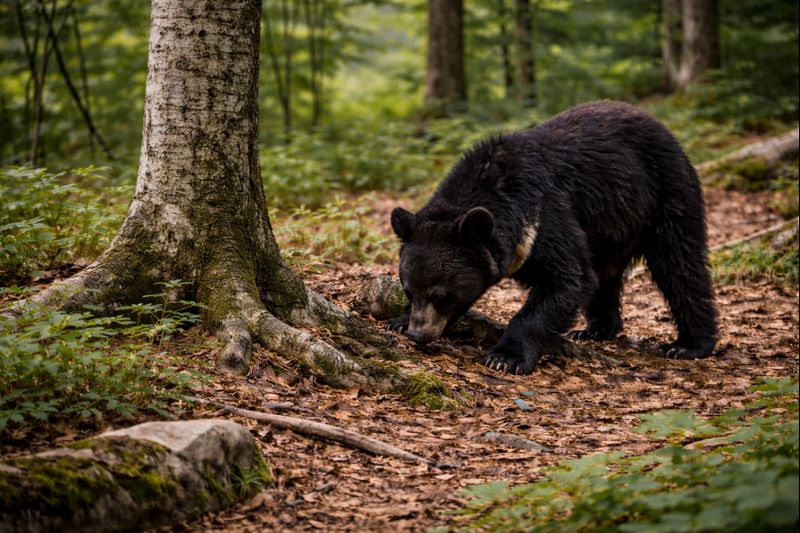
We live in the Anthropocene—an epoch where human activity is the dominant influence on climate and the environment. For the bear, this means their ancestral territories are now crisscrossed by highways, dotted with suburban homes, and scented with the irresistible aroma of human food. Coexistence is not a romantic ideal; it is a rigorous, daily practice of setting boundaries. It requires us to change our behavior so that bears do not have to pay the ultimate price for our negligence.
The goal of modern wildlife management is to keep bears “wild and wary.” When a bear loses its natural fear of humans, it is rarely the human who suffers most in the long run—it is the bear. This chapter explores the innovative strategies we use to share the world with a powerful neighbor while ensuring that both species can thrive in safety.
🐻 Table of Contents
- 🍎 1. The Trap of Easy Calories — Managing Attractants
- 🚧 2. Structural Solutions — Wildlife Corridors and Fencing
- 🔊 3. Aversive Conditioning — Teaching Boundaries
- 🎓 4. Community Education — The “Bear Aware” Movement
- 🐾 A Poetic Reflection
🍎 1. The Trap of Easy Calories — Managing Attractants
The most significant driver of human-bear conflict is “food conditioning.” A bear’s powerful nose can detect a bird feeder or a greasy barbecue from miles away.
- The Garbage Problem: In bear country, standard trash cans are essentially “gift boxes.” The implementation of certified bear-resistant containers is the single most effective tool in preventing bears from entering residential areas.
- Securing the Periphery: Fruit trees, beehives, and livestock are natural draws. By using electric fencing—a low-voltage, non-lethal deterrent—farmers and homeowners can “speak” to the bear in a language of discomfort that it understands and respects.
🚧 2. Structural Solutions — Wildlife Corridors and Fencing
As we fragment the wilderness with roads, we create lethal traps for migrating bears. Modern engineering is now designing the landscape with the bear’s movement in mind.
- Underpasses and Overpasses: Specially designed bridges covered in native vegetation allow bears to cross major highways safely. This maintains genetic flow between isolated populations and prevents high-speed collisions.
- Zoning for Wildlife: By identifying “core habitats” and “travel corridors,” urban planners can direct human development away from the paths bears have used for generations.
🔊 3. Aversive Conditioning — Teaching Boundaries
When a bear enters a human space, managers often use “aversive conditioning” to encourage it to leave and not return. This is the practice of creating a negative experience associated with humans.
- Hazing Techniques: The use of loud noises (cracker shells), beanbag rounds, or specially trained Karelian Bear Dogs helps reinforce the bear’s natural instinct to avoid people.
- Consistency is Key: For conditioning to work, the “lesson” must be consistent. If a bear gets a food reward once, it may take dozens of negative experiences to unlearn that behavior.
🎓 4. Community Education — The “Bear Aware” Movement
Ultimately, the burden of coexistence lies with humans. Education programs like “Bear Smart” or “Bear Aware” focus on changing human psychology.
- Re-framing the Narrative: Moving away from the “monster” archetype toward an understanding of bear biology helps people react calmly and correctly during encounters.
- Public Policy: Communities that pass bylaws requiring attractant management see a dramatic decrease in the number of bears that have to be “destroyed” (euthanized) due to public safety concerns.
🐾 A Poetic Reflection
Coexistence is the art of leaving the porch light off and the gate latched, so the master of the woods may pass by in the dark, undisturbed and unseen.
🐻→ Next Post (Bear 30: The Future of the Wild)
🐻← Previous Post (Bear 28: Hybridization in a Changing World)


コメント