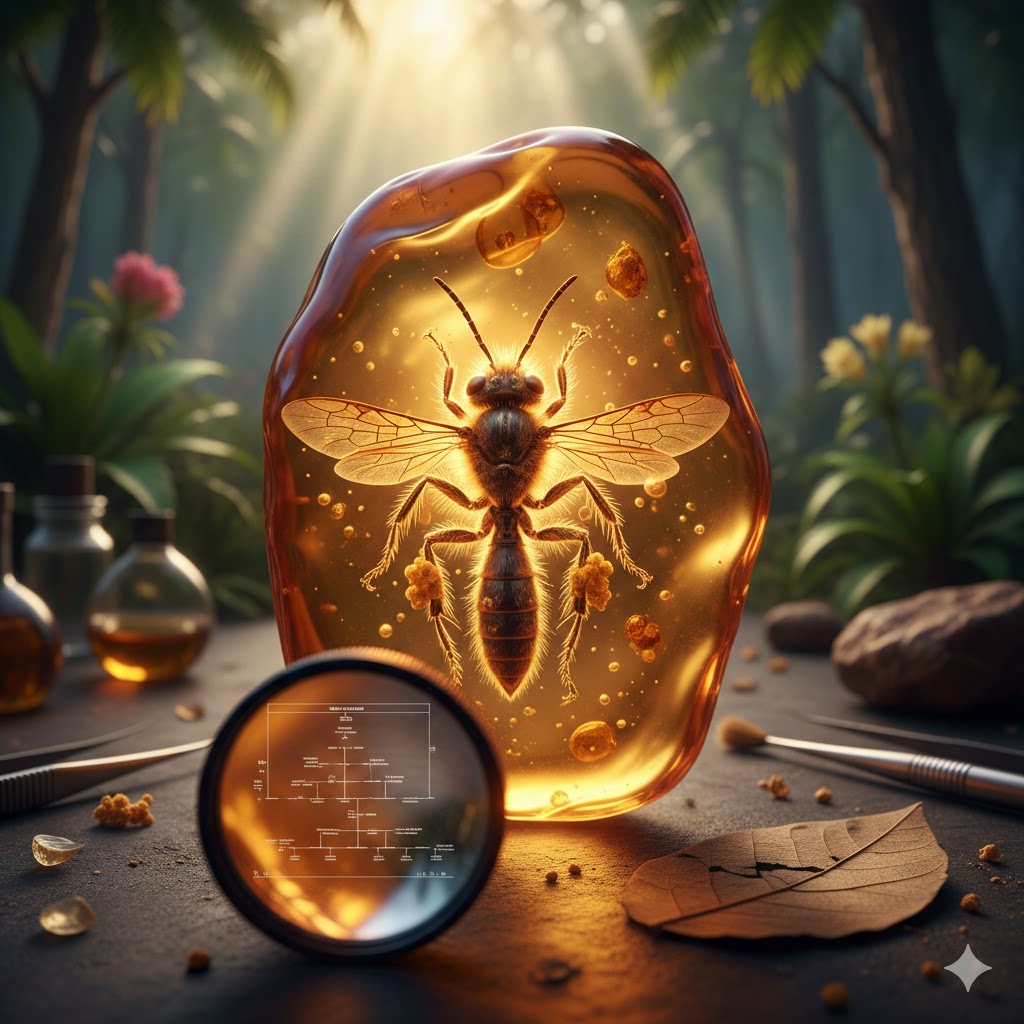
Before the delicate hum of the honeybee graced the air, the world echoed with the predatory buzz of its ancestors. The lineage of Apis—the very word synonymous with nectar and pollen—begins not with flowers, but with fangs. Over 120 million years ago, in the Cretaceous period, sphecoid wasps dominated the skies, relentless hunters feeding their larvae on the flesh of other insects. Yet, within this fierce lineage, a profound alchemy began to stir: a few adventurous individuals opted for a revolutionary diet, trading flesh for the golden dust of pollen. This was the moment the primal predator began its transformation into Earth’s most industrious pollinator.
This was no mere dietary shift; it was a fundamental renegotiation of life on Earth. The bee, in its nascent form, chose symbiosis over solitude, a cooperative dance with the burgeoning angiosperms (flowering plants) that would reshape global ecosystems forever. From the depths of carnivorous ancestry, a new path was forged, one that would lead to the intricate societies, complex communication, and indispensable ecological role of the honeybee we know today.
🐝 Table of Contents
- 🌱 1. The Carnivorous Dawn — Sphecoid Wasps as Ancestors
- 🔄 2. The Great Transmutation — Shifting from Predator to Pollinator
- 🌿 3. The Angiosperm Catalyst — A World in Bloom
- 📜 4. Amber Chronicles — Fossil Evidence of Early Bees
- ✨ A Poetic Reflection
🌱 1. The Carnivorous Dawn — Sphecoid Wasps as Ancestors
The journey of the honeybee begins in the violent yet vital world of the Cretaceous. Their direct ancestors, the sphecoid wasps, were formidable hunters, each with a specialized role in the food chain.
- Order: Hymenoptera (includes ants, wasps, and bees).
- Suborder: Apocrita (waist-wasted insects).
- Lineage: Within the Aculeata (stinging Hymenoptera), bees are monophyletic, meaning they share a single common ancestor from the sphecoid wasps.
- Predatory Lifestyle: Early sphecoid wasps captured other insects, paralyzing them with their sting and carrying them back to their nests to feed their larvae. This provided a rich protein source essential for development.
This predatory foundation provided the anatomical and behavioral toolkit that would later be repurposed for a life among flowers, demonstrating evolution’s remarkable ability to innovate from existing structures.
🔄 2. The Great Transmutation — Shifting from Predator to Pollinator
The transition from meat-eater to pollen-gatherer was not abrupt but a gradual, revolutionary shift driven by ecological opportunity.
- Dietary Shift: It is hypothesized that early sphecoid wasps, while hunting, occasionally ingested pollen adhering to their prey. Recognizing its nutritional value—especially for larvae—some lineages began to actively seek it out.
- Morphological Adaptation: The most significant change was the development of “plumose hairs” (branched or feathery hairs). Unlike the smooth bodies of wasps, these specialized hairs were perfectly designed to trap and transport pollen grains.
- Behavioral Evolution: As dependence on pollen grew, behaviors related to hunting slowly gave way to those focused on floral visitation, leading to the development of sophisticated foraging strategies.
This “great transmutation” fundamentally altered their interaction with the world, setting them on a path of mutual benefit with the plant kingdom.
🌿 3. The Angiosperm Catalyst — A World in Bloom
The evolutionary trajectory of bees is inextricably linked to the rise of angiosperms. Neither could have achieved their current diversity and ecological dominance without the other.
- Co-evolutionary Spark: The Cretaceous period saw an explosive radiation of flowering plants, creating a vast, untapped food source in the form of nectar (for energy) and pollen (for protein).
- Floral Specialization: As bees became more reliant on flowers, plants in turn evolved diverse floral structures, colors, and scents to attract specific pollinators, initiating a complex co-evolutionary arms race.
- Ecological Impact: This partnership dramatically increased the reproductive success of angiosperms, leading to the diversification of forests and ecosystems dominated by flowering plants, which in turn provided more niches for bees.
The blooming world of the Cretaceous was not just a backdrop for bee evolution; it was the very canvas upon which their future was painted.
📜 4. Amber Chronicles — Fossil Evidence of Early Bees
Direct evidence of this ancient transformation comes from remarkable fossils preserved in amber, offering a clear window into deep time.
- Melittosphex burmensis: Discovered in Myanmar amber (approx. 100 million years old), this fossil exhibits a mosaic of wasp-like and bee-like features, including branched hairs and pollen-collecting adaptations. It is considered one of the earliest known bee fossils, demonstrating the transitional form.
- Ancient Pollen Grains: Analysis of pollen found on these early bee fossils confirms their nascent role as pollinators, even while retaining some ancestral traits.
- Geographical Spread: These fossil records help trace the early dispersal of bees, suggesting that their initial evolutionary hotspots coincided with areas of intense angiosperm diversification.
Each amber-encased specimen serves as a tangible record of evolution’s ingenuity, preserving the moment a predator embraced the path of a pollinator.
✨ A Poetic Reflection
It was the most peaceful betrayal, abandoning the sharpened sting for the sun’s golden dust.

コメント