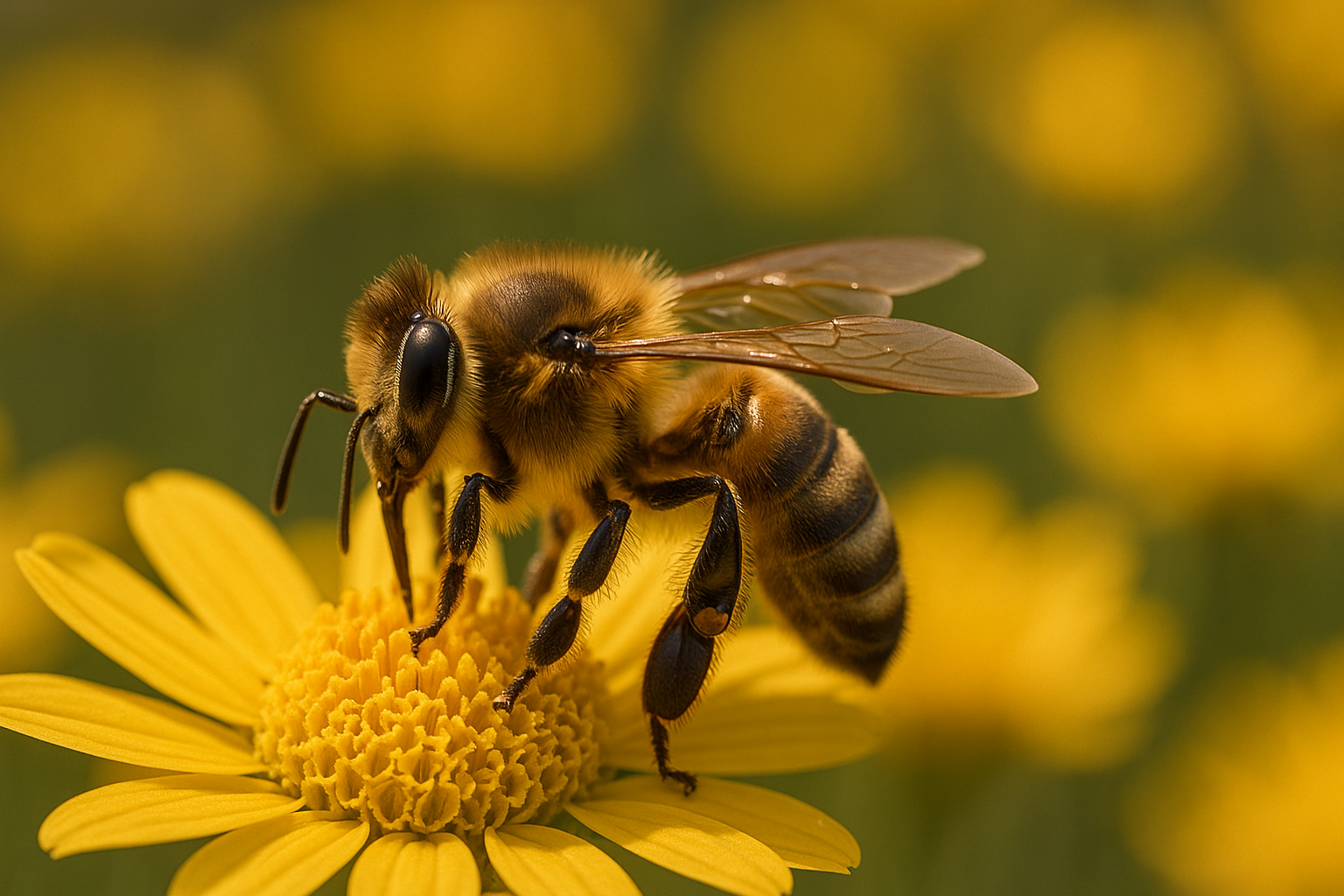
The body of a honeybee is a masterpiece of “bio-mechanical engineering,” refined over eons of evolutionary pressure. Their chitinous exoskeleton is far more than a defensive shell; it is a multi-functional framework that supports internal organs, amplifies muscular output, and houses an intricate array of sensory receptors. Within this resilient armor lies a sophisticated network of exocrine glands—miniature chemical factories that synthesize the pheromones and substances essential for the survival of the superorganism.
📊 Data Profile: Anatomical Foundations
- Primary Material: Sclerotized Chitin (Proteins cross-linked with polysaccharides)
- Segmental Architecture: Head, Thorax (Locomotion), and Abdomen (Metabolism/Defense)
- Major Exocrine Glands: Hypopharyngeal, Mandibular, Nasonov, and Wax glands
- Cuticular Surface: Coated with specialized hydrocarbons for nest-mate recognition
- Sensory Density: Over 3,000 sensilla placodea per antenna
To examine the anatomy of Apis is to study a living vessel where structural integrity meets chemical intelligence, creating a platform capable of both individual endurance and social synchronization.
🐝 Table of Contents
- 🛡️ 1. The Chitin Matrix — Mechanics of the Sclerotized Shell
- ⚗️ 2. The Glandular Map — Spatial Distribution of Chemical Factories
- 🆔 3. Cuticular Hydrocarbons — The Exoskeleton as a Social ID
- 🏗️ 4. Muscular Attachment — The Power of Apodemes in Flight
- ✨ A Poetic Reflection
🛡️ 1. The Chitin Matrix — Mechanics of the Sclerotized Shell
The honeybee’s exoskeleton is a composite material composed of chitin microfibrils embedded in a protein matrix. This provides a high strength-to-weight ratio essential for an airborne insect.
- Flexibility and Rigidity: Hardened plates called sclerites protect vital organs, while flexible arthrodial membranes between segments allow for the abdominal expansion necessary for nectar storage and respiration.
- Desiccation Resistance: The non-living cuticle serves as a primary barrier against water loss, enabling bees to forage in diverse climates without dehydration.
⚗️ 2. The Glandular Map — Spatial Distribution of Chemical Factories
Distributed strategically throughout the body, exocrine glands are the engines of bee society. Their placement is optimized for immediate deployment of their products.
- The Head Unit: Hypopharyngeal glands produce the protein-rich components of Royal Jelly, while mandibular glands secrete pheromones that signal alarm or colonial status.
- The Abdominal Unit: On the ventral side, wax glands secrete the building blocks of the hive. Posteriorly, the Nasonov gland releases orientation pheromones to guide lost foragers back to the entrance.
🆔 3. Cuticular Hydrocarbons — The Exoskeleton as a Social ID
The outermost layer of the armor is coated with a complex cocktail of cuticular hydrocarbons (CHCs). This chemical “wax” is far more than a moisture barrier; it is the fundamental mechanism of social recognition.
Each colony possesses a unique hydrocarbon signature. When bees touch antennae, they are “reading” this signature to verify if the individual is a nest-mate or a drifting intruder. The armor itself is the medium for the hive’s security system.
🏗️ 4. Muscular Attachment — The Power of Apodemes in Flight
Inside the thorax, the exoskeleton folds inward to form rigid internal ridges known as apodemes. These serve as the attachment points for the massive indirect flight muscles.
By slightly deforming the shape of the thoracic shell, these muscles drive the high-frequency oscillation of the wings. The structural integrity of the chitinous box is what allows the bee to generate the torque and lift required to transport payloads often exceeding half its own body weight.
✨ A Poetic Reflection
It is a suit of steel-will draped in golden down—a living gear that speaks in the language of chemistry.
🐝→ Next Post (Apis 12: The Aerodynamics of Wings)
🐝← Previous Post (Apis 10: Island Endemics)
🐝→ Back to Series: The Apis Records


コメント