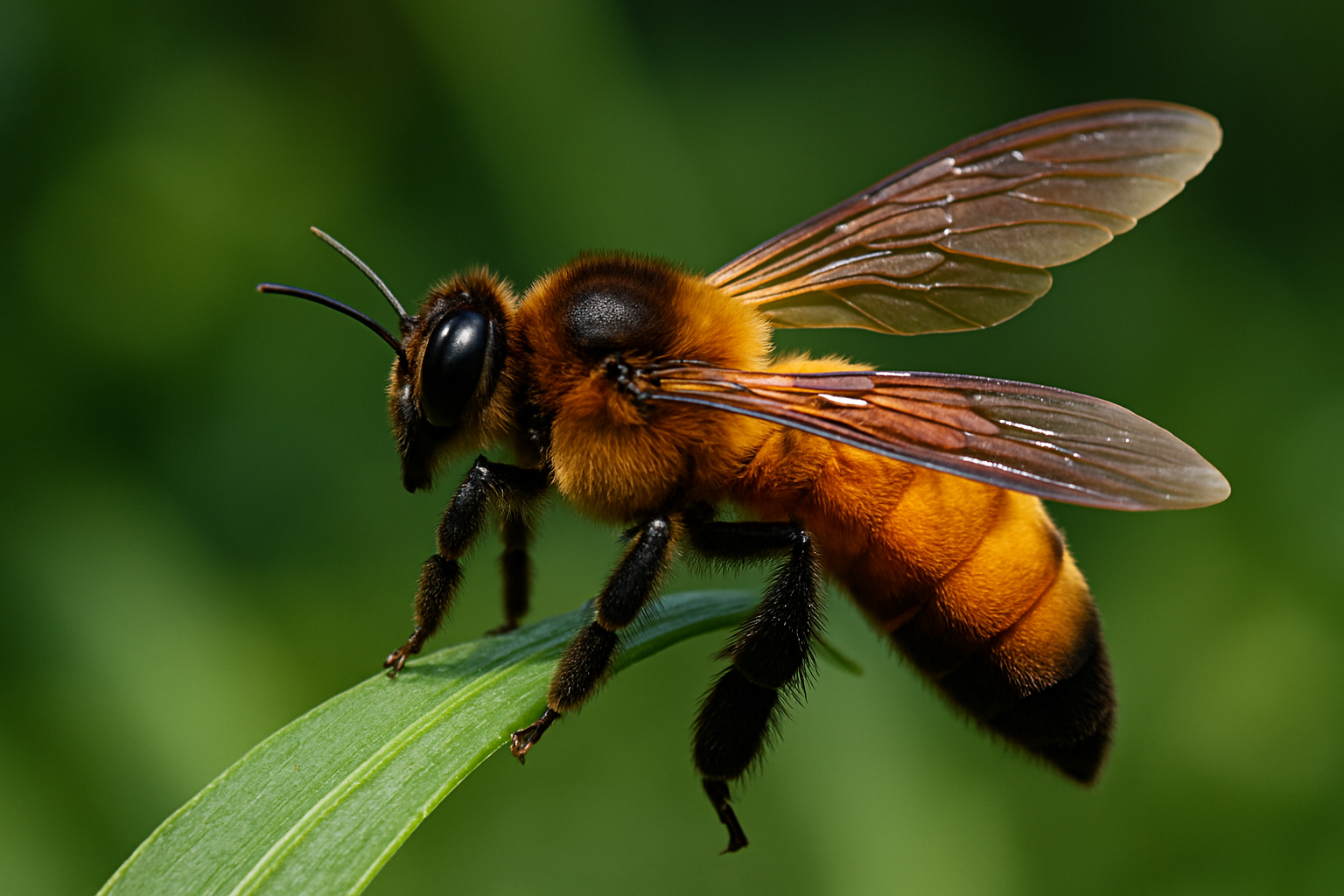
In the early days of aviation theory, it was often joked that the honeybee defies the laws of physics—that its body is too heavy and its wings too small for flight. Yet, the bee excels where machines falter. Their flight is not a simple flapping motion, but a sophisticated manifestation of “unsteady fluid dynamics.” By oscillating their wings at a staggering 230 times per second, honeybees manipulate the very viscosity of air, creating vortices that act as invisible engines of lift. They do not merely move through the air; they choreograph it.
📊 Data Profile: Aerodynamic Specifications
- Wing Beat Frequency: Consistent ~230 Hz (independent of payload)
- Stroke Amplitude: Short, high-frequency arcs (approx. 90°)
- Lift Mechanism: Leading-Edge Vortex (LEV) and Wake Capture
- Wing Coupling: Hamuli (microscopic hooks connecting fore and hind wings)
- Flight Power: Indirect flight muscles (asynchronous muscle contraction)
To analyze Apis in flight is to witness a masterpiece of high-frequency engineering, where the limits of biological tissue meet the complex mathematics of the sky.
🐝 Table of Contents
- 🌀 1. The Leading-Edge Vortex — Harvesting the Power of the Whirlwind
- 🔄 2. Wake Capture — The Recycled Energy of the Stroke
- 🪝 3. The Hamuli Mechanism — Integrating Two Wings into One
- ⚙️ 4. Thoracic Deformation — The Engines of Indirect Flight
- ✨ A Poetic Reflection
🌀 1. The Leading-Edge Vortex — Harvesting the Power of the Whirlwind
The primary secret to bee flight lies in the “Leading-Edge Vortex” (LEV). As the wing sweeps down at a steep angle, a small, persistent vortex forms at the front edge. This vortex creates a pocket of low pressure, effectively “sucking” the wing upward.
- Delayed Stall: Unlike fixed-wing aircraft, which lose lift if tilted too sharply (stalling), the bee maintains this vortex through high-frequency oscillation, preventing the airflow from detaching and ensuring constant lift.
🔄 2. Wake Capture — The Recycled Energy of the Stroke
At the end of each wing stroke, the bee rotates its wings with surgical precision. This allows them to interact with the turbulent air left behind by the previous stroke.
By “capturing their own wake,” bees extract additional energy from the air that would otherwise be wasted as heat or turbulence. This makes them exceptionally efficient hovering machines, capable of remaining perfectly still in front of a flower despite high-frequency vibration.
🪝 3. The Hamuli Mechanism — Integrating Two Wings into One
Honeybees possess four wings, but they fly as if they have two. This is achieved through a row of microscopic hooks called “hamuli” located on the front edge of the hind wing.
These hooks lock onto a fold on the rear edge of the forewing. This coupling creates a single, larger aerodynamic surface that maximizes lift and provides the structural rigidity necessary to withstand the intense g-forces of high-speed maneuvers.
⚙️ 4. Thoracic Deformation — The Engines of Indirect Flight
The wings are not attached to muscles directly. Instead, the honeybee uses “indirect flight muscles” that deform the shape of the entire thorax.
Vertical muscles pull the roof of the thorax down, causing the wings to flip up; longitudinal muscles then squeeze the thorax, snapping the wings down. Because these muscles are “asynchronous,” they can contract multiple times per nerve impulse, enabling frequencies that far exceed the limits of traditional biological systems.
✨ A Poetic Reflection
It is the physics of turning a whirlwind into a melody—where a tiny heartbeat carves a golden path through the silent sky.
🐝→ Next Post (Apis 13: Spectral Vision)
🐝← Previous Post (Apis 11: The Chitin Armor)
🐝→ Back to Series: The Apis Records
コメント