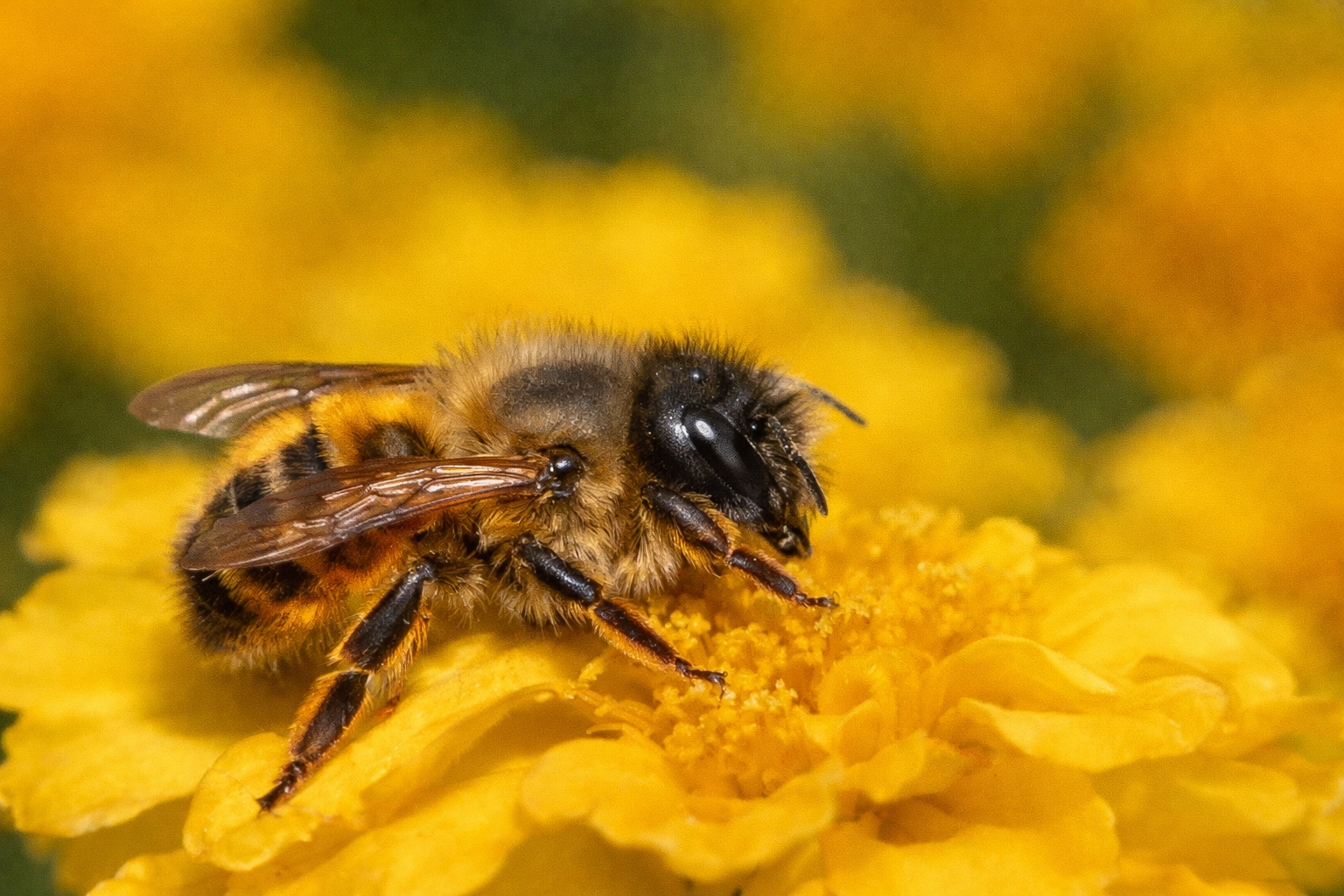
The world as perceived by the honeybee exists in a dimension far beyond human comprehension. To an Apis, the sky is not a simple blue dome, but a “polarized compass” indicating the sun’s exact coordinates, and flowers are not merely colorful petals, but “ultraviolet targets” glowing in the darkness. The visual system of the honeybee is an advanced image-processing unit, optimized for high-speed navigation and the instantaneous detection of rewards amidst a sea of complex environmental noise.
To analyze the spectral vision of Apis is to step into a non-human-centric reality where light is a tool for navigation and color is a biological contract.
🐝 Table of Contents
- 💜 1. The Ultraviolet Frontier — Seeing the Invisible “Nectar Guides”
- 🧭 2. Polarized Light Navigation — The Celestial Compass
- ⚡ 3. High-Speed Processing — Temporal Resolution and Motion Detection
- 👁️ 4. Compound Eye Architecture — The Mechanics of the Ommatidia
- ✨ A Poetic Reflection
💜 1. The Ultraviolet Frontier — Seeing the Invisible “Nectar Guides”
While humans are blind to wavelengths below 400nm, honeybees utilize the ultraviolet spectrum as their primary channel for floral identification. This “UV vision” transforms the landscape into a functional map of resources.
- Targeting Systems: Many flowers that appear uniform to us possess intricate ultraviolet absorption patterns at their centers. These “nectar guides” act as landing lights, directing the bee with surgical precision to the pollen and nectar.
- Bee Purple: By combining UV and yellow-green signals, bees perceive a unique color known as “bee purple,” a hue that exists entirely outside the human visual experience.
🧭 2. Polarized Light Navigation — The Celestial Compass
The dorsal rim area of the honeybee’s compound eye contains specialized ommatidia sensitive to the polarization of skylight. This allows them to navigate even on overcast days.
By detecting the e-vector patterns of scattered sunlight, the bee can determine the sun’s position relative to its hive. This celestial geometry is integrated into the “Waggle Dance,” allowing a scout to communicate the location of a resource with mathematical accuracy, regardless of cloud cover.
⚡ 3. High-Speed Processing — Temporal Resolution and Motion Detection
Flight at 30 km/h through a tangled forest requires a frame rate far superior to human vision. The honeybee’s flicker fusion frequency is approximately 300Hz—five times faster than our own.
This high temporal resolution means that for a bee, the world moves in slow motion. This prevents “motion blur,” allowing the bee to identify individual flowers while traveling at high speeds and to react to the subtle movements of predators or the swaying of floral stems in the wind.
👁️ 4. Compound Eye Architecture — The Mechanics of the Ommatidia
Each compound eye is composed of thousands of hexagonal units called ommatidia. Each unit is a self-contained optical system, capturing light from a specific angle. This provides the bee with a panoramic view of nearly 360 degrees, making it almost impossible to approach a bee undetected.
The integration of these thousands of data points within the miniature brain of the bee allows for the construction of a 3D spatial map, a feat of neural efficiency that continues to inspire modern robotic vision systems.
✨ A Poetic Reflection
It is the light that sees through the clouds to find the sun, and pierces the dark to find the hidden truth of a flower.
🐝→ Next Post (Apis 14: The Chemical Antenna)
🐝← Previous Post (Apis 12: The Aerodynamics of Wings)
🐝→ Back to Series: The Apis Records
コメント