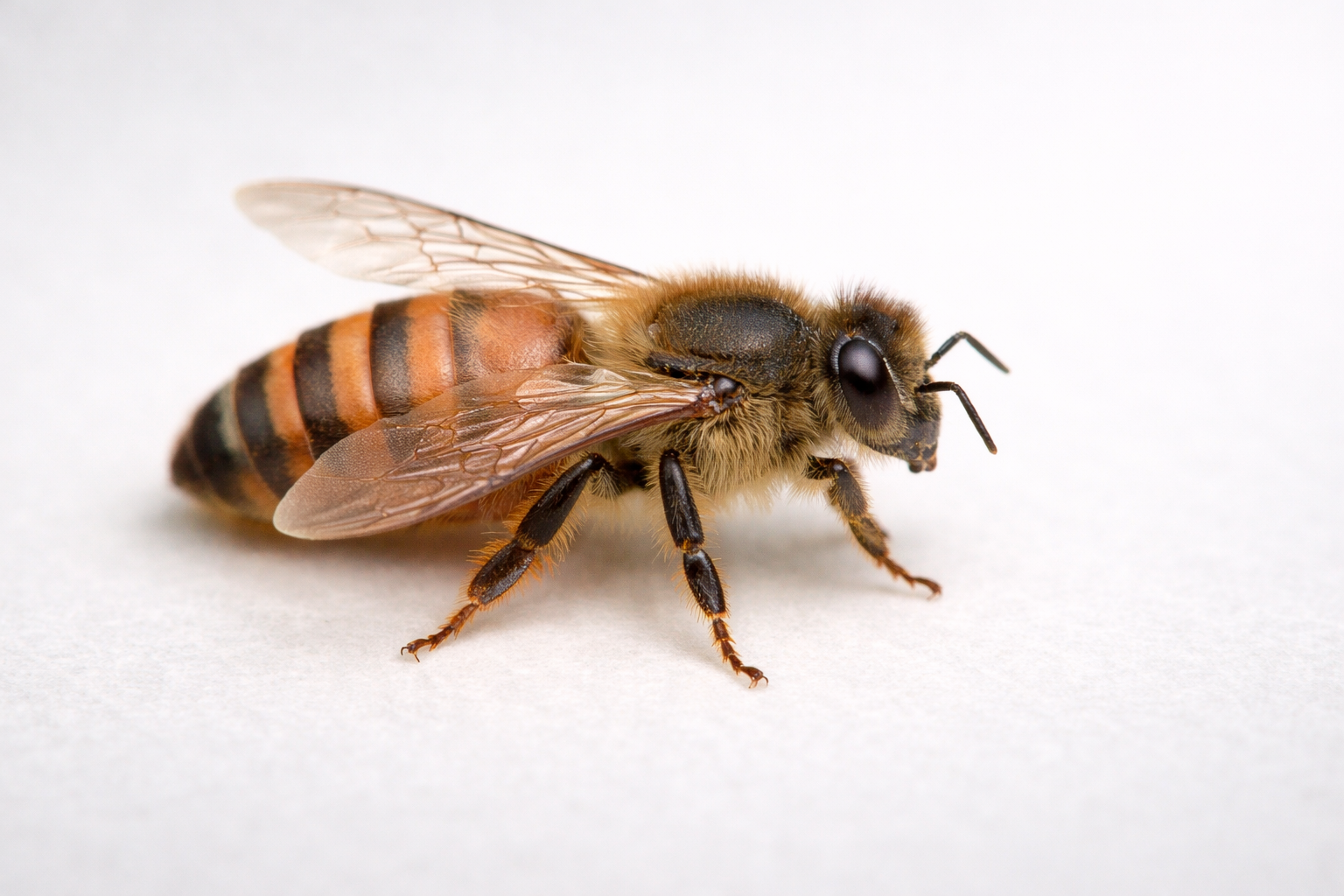
The Queen Bee is the absolute center of the hive, the vessel of the superorganism’s shared DNA. However, her dominion is not enforced through physical might, but through an invisible fog of chemical commands known as “Queen Substance.” How a single mother suppresses the ovaries of tens of thousands of daughters, transforming them into devoted laborers, is a marvel of physiological engineering. This mechanism demonstrates the extreme limits of evolution, where individual desire is subordinated to the survival of the collective.
📊 Data Profile: The Queen’s Specification
- Primary Pheromone: Queen Mandibular Pheromone (QMP / 9-ODA)
- Reproductive Capacity: 1,500–2,000 eggs/day during peak season
- Spermatheca: Specialized organ for multi-year sperm viability
- Longevity: 2–5 years (unusually high for a non-hibernating insect)
- Developmental Switch: Epigenetic triggers induced by Royal Jelly consumption
To examine the physiology of the Queen is to analyze the “biological dynamo” that drives the hive—a state of existence where chemical dominance ensures social harmony and reproductive continuity.
🐝 Table of Contents
- ⚗️ 1. The Pheromonal Code — QMP and Social Suppression
- 🧬 2. Epigenetic Transformation — Royal Jelly as a Genetic Key
- ❄️ 3. The Spermatheca — A Living Reservoir of Genetic Diversity
- 🚨 4. The Signal of Absence — Supercedure and Emergency Cells
- ✨ A Poetic Reflection
⚗️ 1. The Pheromonal Code — QMP and Social Suppression
The primary tool of the Queen’s governance is the Queen Mandibular Pheromone (QMP). This complex blend of molecules, specifically 9-oxo-2-decenoic acid (9-ODA), functions as a systemic lubricant for bee society.
- Ovarian Suppression: QMP circulates throughout the hive via “trophallaxis” (food sharing). In workers, it acts at a hormonal level to prevent the development of ovaries, ensuring that all non-queen individuals remain focused on the collective tasks of foraging and brood rearing.
- Rallying Signal: The scent attracts workers for grooming and feeding, creating a “court” that facilitates the rapid distribution of her chemical status to the furthest reaches of the comb.
🧬 2. Epigenetic Transformation — Royal Jelly as a Genetic Key
A Queen and a worker are genetically identical at birth. Their divergent paths are determined entirely by their diet during the first three days of the larval stage. While all larvae receive some Royal Jelly, only the future Queen is bathed in it exclusively.
Royal Jelly acts as an “epigenetic switch,” inhibiting a specific enzyme (Dnmt3) that usually silences queen-specific genes. This dietary alchemy results in the development of fully functional ovaries, a significantly larger body size, and a lifespan extended by more than fortyfold compared to her sisters.
❄️ 3. The Spermatheca — A Living Reservoir of Genetic Diversity
The Queen possesses a unique anatomical feature called the spermatheca. After her nuptial flights, she stores millions of sperm cells within this specialized sac. To keep them viable for years, the organ maintains a highly controlled environment, rich in antioxidants and precise nutrient concentrations.
This biological “deep freeze” allows her to fertilize eggs throughout her life without ever needing to mate again, ensuring that the hive remains a vibrant tapestry of genetic lineages from the various drones she encountered in her youth.
🚨 4. The Signal of Absence — Supercedure and Emergency Cells
The stability of the hive is contingent on the constant presence of the Queen’s chemical signal. If her pheromones weaken due to age or injury, the workers detect the “chemical void” within hours.
This absence triggers an immediate architectural response: the construction of emergency queen cells. The superorganism senses its own mortality and initiates the “supercedure” process, selecting a young larva to be the next vessel for the hive’s genetic future. The Queen’s power is absolute, but it is entirely dependent on her ability to broadcast her vitality.
✨ A Poetic Reflection
It is a silent code woven with fragrance—where one mother binds ten thousand daughters into a single, unyielding will.
🐝→ Next Post (Apis 17: The Drone’s Singularity)
🐝← Previous Post (Apis 15: The Toxic Barometer)
🐝→ Back to Series: The Apis Records

コメント