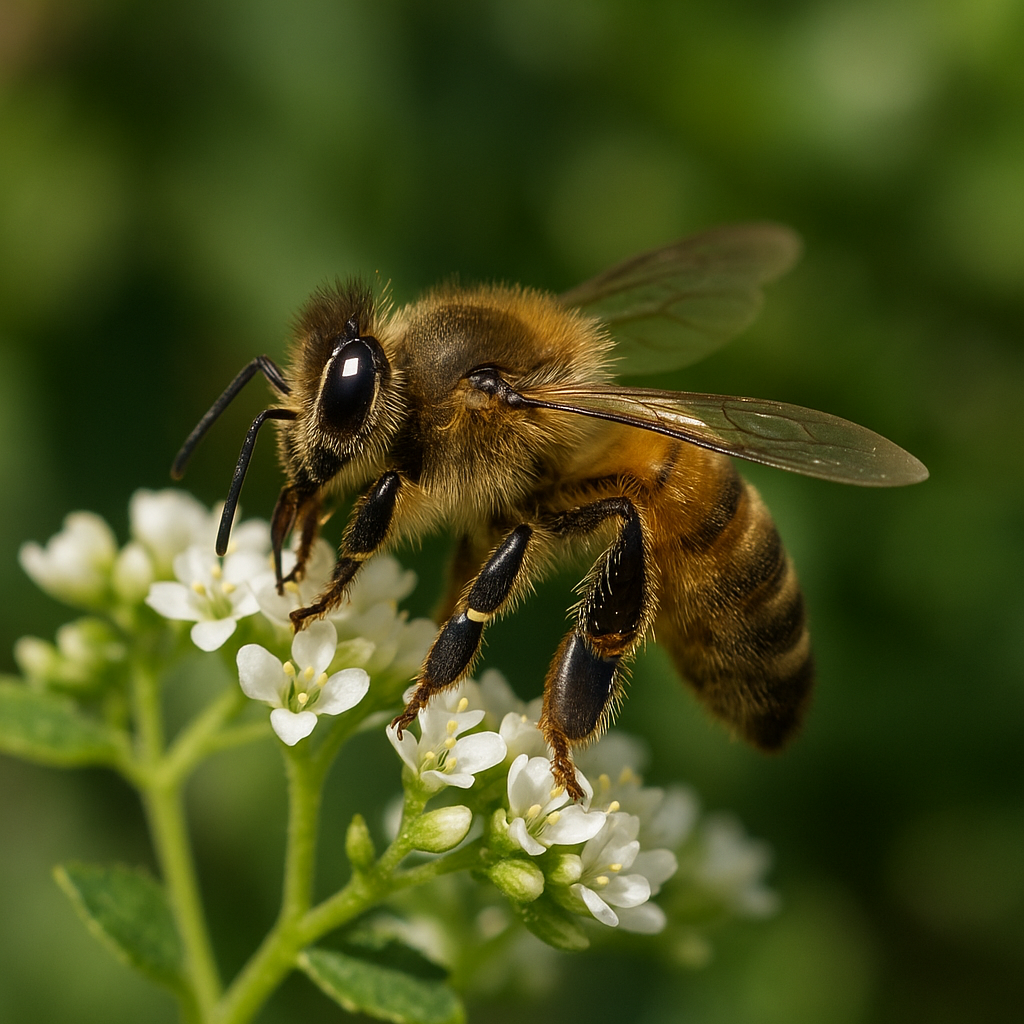
The honeybee brain, a mere cubic millimeter containing approximately one million neurons, possesses a computational density that rivals modern supercomputers. Their ability to navigate vast, ever-changing landscapes and return with surgical precision is driven by “Cognitive Cartography.” This is not a sequence of simple reflexes, but a high-level parallel processing of data—merging an internal celestial ephemeris, a visual odometer, and landmark-based spatial memory within the mushroom bodies. To witness Apis is to witness the biological encoding of geometry.
To analyze the Cognitive Cartography of Apis is to explore a neural landscape where visual input is translated into a rigorous spatial ledger, allowing the individual to transcend its size through the power of calculation.
🐝 Table of Contents
- 🧠 1. The Mushroom Bodies — The Engine of Spatial Memory
- ⏳ 2. The Optical Odometer — Measuring Distance through Flow
- 📐 3. Vector Integration — Calculating the Direct Homing Line
- 🗺️ 4. Landmark Recognition — The Internal 3D Map
- ✨ A Poetic Reflection
🧠 1. The Mushroom Bodies — The Engine of Spatial Memory
The mushroom bodies (MBs) are the most striking feature of the bee brain, particularly developed in social Hymenoptera. They act as the central hub for multimodal sensory integration, where olfactory signals from the antennae meet visual data from the compound eyes.
- Kenyon Cells: Within the MBs, hundreds of thousands of Kenyon cells create an intricate network that processes complex patterns. This is the site where a forager stores the specific “color-scent-coordinate” profiles of high-yield floral patches.
- Dynamic Restructuring: As a worker matures from hive duties to foraging, the volume of the MB neuropil increases, effectively “upgrading” the hardware to handle the influx of environmental data.
⏳ 2. The Optical Odometer — Measuring Distance through Flow
Honeybees do not measure distance by time or wingbeats; they use an “Optical Odometer.” By calculating the speed at which images (optical flow) move across their retina, they integrate the total visual transit into a measure of distance.
Research has shown that bees flying through narrower, more visually textured environments perceive a greater distance than those flying over open water. This visual odometer is integrated with their internal energy gauge, allowing the bee to relay the “effort” of a trip back to the hive with mathematical consistency.
📐 3. Vector Integration — Calculating the Direct Homing Line
Perhaps the most advanced feat of bee cognition is vector integration (or path integration). While a bee may wander in an erratic, winding path to find multiple nectar sources, she does not need to retrace her steps to return to the nest.
By continuously summing the vectors of her outward movement relative to the sun and landmarks, the bee’s brain solves the “Traveler’s Problem” in real-time, allowing her to fly a straight “bee-line” home. This demonstrates a non-linear spatial reasoning that suggests a truly map-like internal representation of the environment.
🗺️ 4. Landmark Recognition — The Internal 3D Map
Bees utilize a hierarchical system for localization. While the celestial compass provides a global heading, terrestrial landmarks—trees, rock formations, and forest edges—serve as localized “anchors” for their internal map.
Studies have confirmed that if a forager is displaced to an unfamiliar location within her flight range, she can perform “re-orientation” flights, recognize distant landmarks, and successfully calculate a novel route back to a known coordinate. This map-based navigation allows for an unparalleled level of adaptive foraging, turning the landscape into a transparent ledger of known resources.
✨ A Poetic Reflection
An infinite territory contained within a single grain of sand; with every wingbeat, the world is woven with threads of neurons.
🐝→ Next Post (Apis 21: The Hexagonal Gospel)
🐝← Previous Post (Apis 19: The Waggle Calculus)
🐝→ Back to Series: The Apis Records
コメント