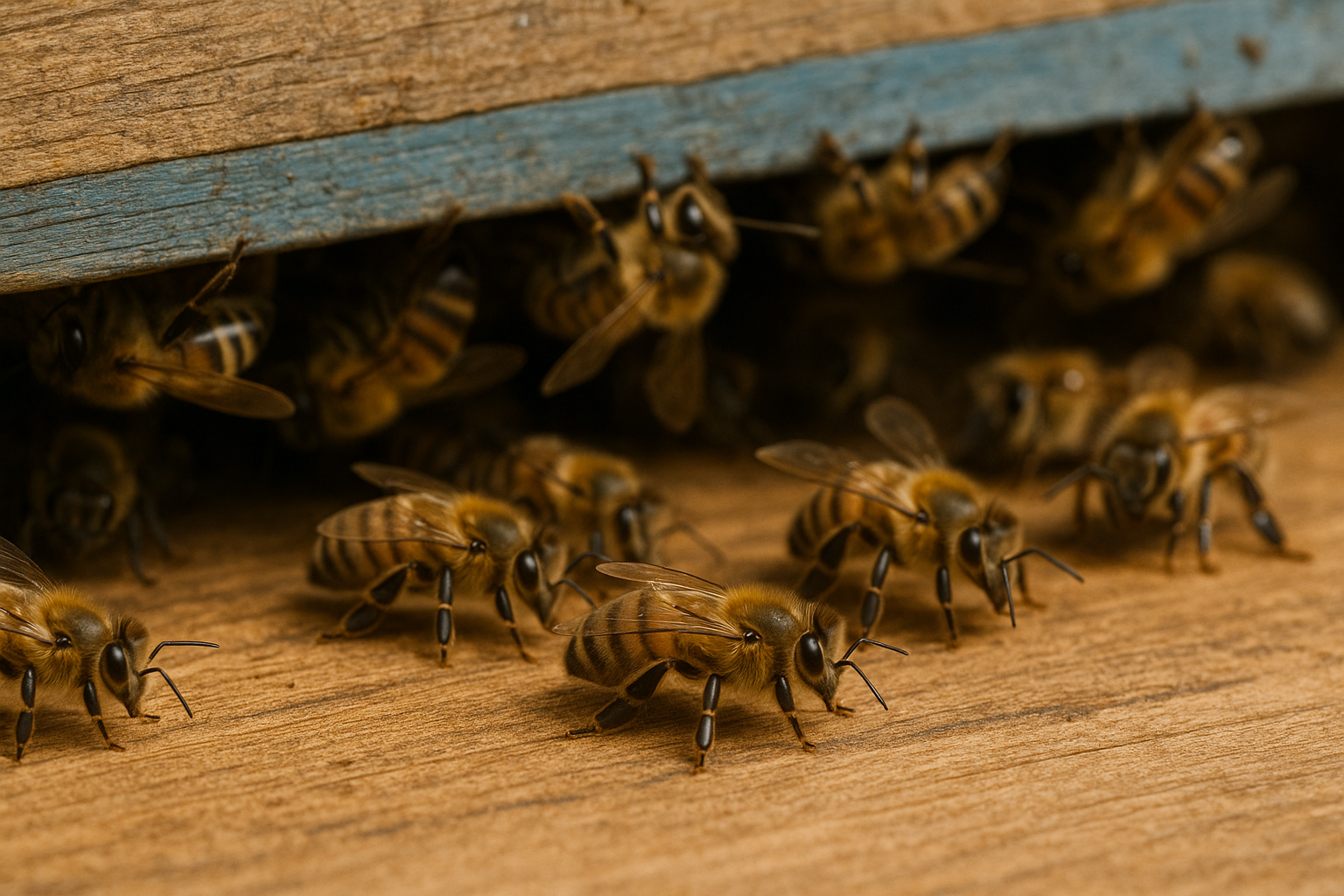
An individual honeybee is an ectotherm, a creature at the mercy of environmental temperatures. However, when thousands of individuals integrate into a superorganism, they achieve a state of endothermy comparable to that of mammals. Whether in the grip of a sub-zero winter or beneath a scorching desert sun, the central brood nest is maintained at a precise 35.0°C. This thermodynamic control—Social Homeostasis—is a masterpiece of biological engineering, where micro-behaviors are aggregated into a stable, macroscopic climate.
🐝 Table of Contents
- 🔥 1. Shivering Thermogenesis — The Anatomy of Living Heaters
- ❄️ 2. The Winter Cluster — Dynamic Insulation and Convection
- 🌬️ 3. Active Ventilation — Evaporative Cooling and Fluid Dynamics
- 🧠 4. Thermal Sensing — The Distributed Thermostat
- ✨ A Poetic Reflection
🔥 1. Shivering Thermogenesis — The Anatomy of Living Heaters
To combat the cold, worker bees utilize “shivering thermogenesis.” By uncoupling their wings from their powerful indirect flight muscles, they can contract these muscles at high frequencies without taking flight. This process converts metabolic energy directly into heat. Specialized individuals, often called “heater bees,” can raise their thoracic temperature to nearly 44°C. By pressing their thorax against the wax walls or crawling into empty cells within the brood area, they act as living radiators, conducting heat directly to the developing larvae.
❄️ 2. The Winter Cluster — Dynamic Insulation and Convection
In extreme cold, the colony forms a “winter cluster.” This is a highly organized, spherical mass of bees surrounding the queen. The outer layer consists of tightly packed workers facing inward, their bodies creating a living insulation shell that prevents the escape of metabolic heat.
This structure is not static; it is a dynamic convection system. As the workers on the periphery cool down, they move toward the warmer center, while warmer bees from the interior take their place on the exterior. This continuous rotation ensures that no individual perishes from exposure while maintaining the core temperature necessary for the queen’s survival.
🌬️ 3. Active Ventilation — Evaporative Cooling and Fluid Dynamics
When the hive faces the threat of overheating, the superorganism switches from heating to active refrigeration. This involves a complex coordination of fluid dynamics and phase change. Water-collecting foragers bring droplets into the hive, spreading them in thin films over the cell rims.
Simultaneously, lines of fanning bees position themselves at the hive entrance. By orienting their bodies and beating their wings in synchronized patterns, they create a powerful forced-air current. This airflow facilitates “evaporative cooling,” drawing heat away from the brood as the water vaporizes. The architecture of the hive is used as a wind tunnel, directing cool air in and humid, hot air out with industrial efficiency.
🧠 4. Thermal Sensing — The Distributed Thermostat
The precision of this homeostasis requires a sophisticated sensory network. Honeybees possess highly sensitive thermal receptors on their antennae, capable of detecting temperature fluctuations as small as 0.2°C. This distributed sensing allows the colony to act as a “stochastic thermostat.” There is no central controller; instead, individual bees respond to local temperature cues. When a threshold is crossed, a specific percentage of the workforce switches to heating or fanning, creating a stabilized feedback loop that keeps the entire system in equilibrium.
✨ A Poetic Reflection
A single bonfire lit by ten thousand heartbeats, a flame that never wavers even in the throat of an icy gale.
🐝→ Next Post (Apis 23: The Enzyme Laboratory)
🐝← Previous Post (Apis 21: The Hexagonal Gospel)
🐝→ Back to Series: The Apis Records
コメント