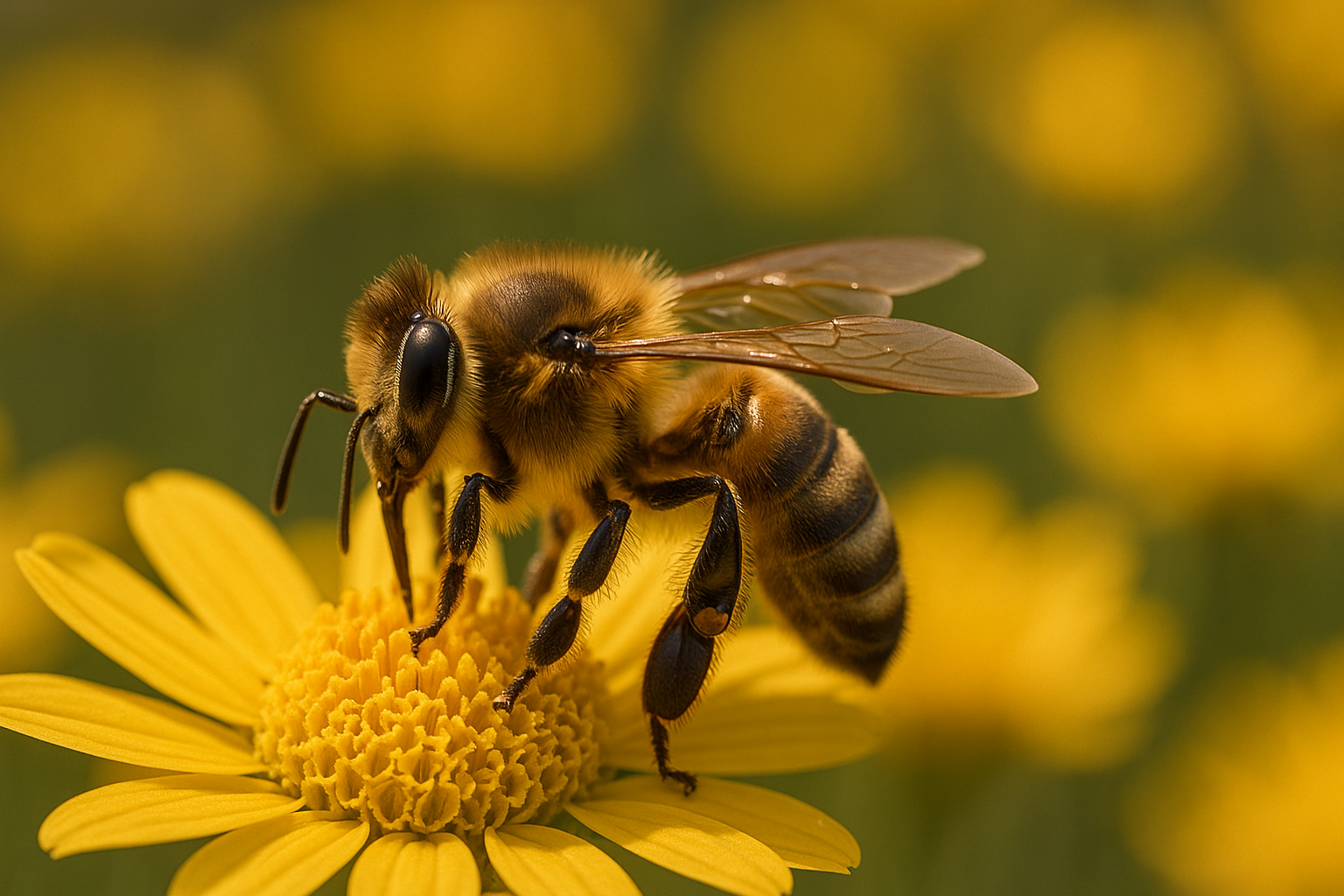
The modern global food supply chain rests upon a vast, invisible pair of wings. The process of pollination by Apis mellifera is no longer merely a biological event; it is an essential infrastructure of the world economy, generating hundreds of billions of dollars in value annually. One out of every three bites of food we consume—including the majority of our fruits, vegetables, and nuts—exists only because of their “unpaid labor.” This episode dissects the structural vulnerability of Anthropocene agriculture and the role of honeybees as biological capital in the framework of global food security.
🐝 Table of Contents
- 📈 1. Biological Capital — The Quantitative Value of Pollination
- 🌾 2. The Monoculture Paradox — Concentration vs. Biodiversity
- 🍎 3. Nutritional Security — Beyond Caloric Volume
- ⚠️ 4. Infrastructural Decay — The Cost of Pollinator Loss
- ✨ A Poetic Reflection
📈 1. Biological Capital — The Quantitative Value of Pollination
According to data from the Food and Agriculture Organization (FAO), 75% of the world’s leading food crops depend to some extent on animal pollination. Economists estimate the global value of this ecosystem service to be between $235 billion and $577 billion per year. Unlike machinery or chemicals, this service is a “public good” provided by nature, functioning as external economies that sustain agricultural profitability. Without the honeybee, the cost of manual pollination or the resulting crop failures would trigger a catastrophic collapse in the commodity markets of the primary sector.
🌾 2. The Monoculture Paradox — Concentration vs. Biodiversity
Modern industrial agriculture has created a dangerous paradox. To achieve economies of scale, vast landscapes are converted into monocultures—single-crop environments like the almond groves of California. While these regions demand massive pollination services for a few weeks a year, they are biological deserts for the rest of the season. This necessitates the “industrial migration” of bees; for instance, nearly half of all managed honeybee colonies in the United States are trucked to California every February. This extreme concentration stresses the biological limits of the hive, exposing them to pathogens and nutritional deficiencies in a landscape devoid of floral diversity.
🍎 3. Nutritional Security — Beyond Caloric Volume
The “Pollination Economy” is less about total calories (staples like wheat and rice are wind-pollinated) and more about nutritional density. Bees are the primary facilitators for crops rich in micronutrients, such as Vitamin A, Vitamin C, and essential lipids. The loss of pollination services would not necessarily lead to a total lack of calories, but rather to a “malnutrition crisis,” as the prices of nutrient-dense foods like fruits and legumes would skyrocket, becoming inaccessible to the world’s most vulnerable populations.
⚠️ 4. Infrastructural Decay — The Cost of Pollinator Loss
In the Anthropocene, we are witnessing the “depreciation” of our biological capital. The synergistic effects of systemic pesticides (neonicotinoids), habitat fragmentation, and climate-induced phenological mismatches (where flowers bloom before bees emerge) are eroding the reliability of pollination services. A decrease in honeybee health does not just mean fewer fruits; it means lower quality—misshapen produce, reduced shelf life, and diminished sugar content. Investing in honeybee health is, therefore, not an act of charity, but a strategic imperative for the maintenance of the global agricultural ledger.
✨ A Poetic Reflection
It is the invisible currency spun from a trillion wingbeats—a silent labor that transforms the specter of hunger into a golden harvest.
🐝→ Next Post (Apis 28: Neurotoxins and Paradigms)
🐝← Previous Post (Apis 26: Ancient Apiaries)
🐝→ Back to Series: The Apis Records
コメント