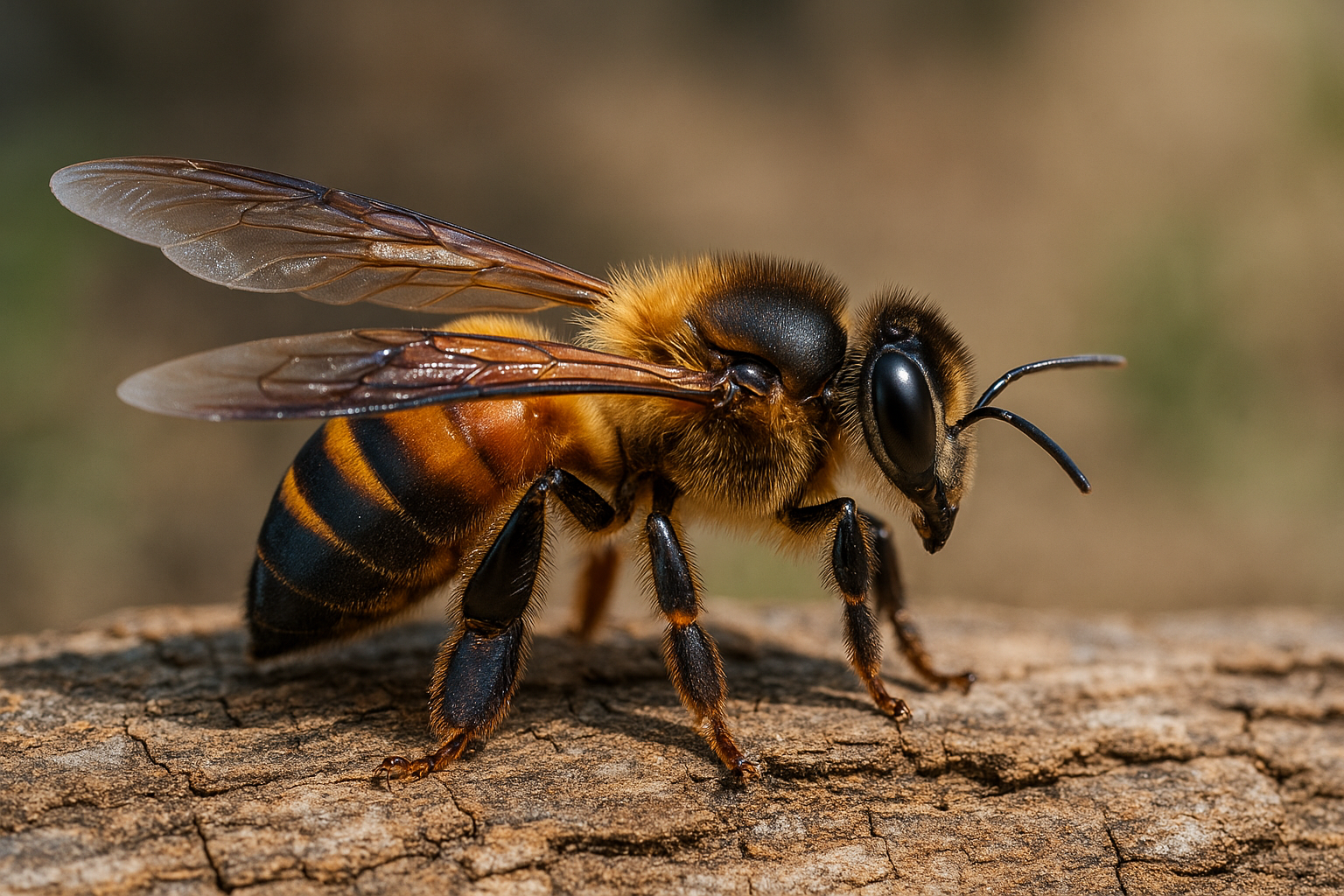
On the sheer precipices of the Himalayas, where oxygen is scarce and the wind carries the bite of eternal ice, a jet-black titan reigns supreme. Apis laboriosa—the Himalayan Giant Honey Bee—is the most extreme adaptation within the genus Apis. How they sustain the fire of life where other bees would succumb to the frost is a marvel of evolutionary engineering. Their existence is a synthesis of cryobiology, high-altitude physiology, and a legendary symbiosis with the toxic flora of the world’s highest peaks.
📊 Data Profile: Apis laboriosa
- Scientific Name: Apis laboriosa (Smith, 1871)
- Common Name: Himalayan Giant Honey Bee
- Altitude Limit: Approx. 4,100 meters (The world’s highest)
- Physical Characteristic: Jet-black chitin (High melanin content)
- Thermoregulation: Specialized cryobiological endurance
- Specialty: Production of “Mad Honey” (Grayanotoxin-rich nectar)
To study Apis laboriosa is to peer into the limits of biological endurance, observing a lineage that has traded the ease of the plains for the perilous sanctuary of the clouds.
🐝 Table of Contents
- 🕶️ 1. The Melanic Shield — Solar Absorption and UV Defense
- 🫁 2. Hypoxic Mastery — Metabolism in Thin Air
- 🧗 3. Vertical Nomads — The Seasonal Ascent and Descent
- 🍯 4. The Alchemy of Grayanotoxin — The Origins of Red Honey
- ✨ A Poetic Reflection
🕶️ 1. The Melanic Shield — Solar Absorption and UV Defense
The striking jet-black coloration of Apis laboriosa is far from aesthetic. It is a critical survival mechanism for life in the high-altitude biome.
- Thermal Optimization: Darker surfaces absorb solar radiation more efficiently. In the frigid Himalayan air, this melanin-rich exoskeleton acts as a bio-solar panel, allowing bees to maintain the thoracic temperature required for flight even in near-freezing conditions.
- Radiation Protection: At high altitudes, UV radiation is significantly more intense. High concentrations of melanin protect the bee’s delicate internal tissues from DNA damage caused by unshielded solar rays.
🫁 2. Hypoxic Mastery — Metabolism in Thin Air
At 4,000 meters, the partial pressure of oxygen is nearly 40% lower than at sea level. Sustaining the high-frequency wingbeats necessary for flight in such thin air requires exceptional respiratory efficiency.
- Enzymatic Adaptation: Apis laboriosa has optimized its mitochondrial enzymes to maintain high energy output under hypoxic conditions.
- Flight Mechanics: They exhibit a slightly larger wing-to-body ratio compared to other Apis species, providing the necessary lift in the less dense atmospheric layers of the high Himalayas.
🧗 3. Vertical Nomads — The Seasonal Ascent and Descent
Unlike the horizontal migrations of their cousins, Apis laboriosa are vertical nomads. Their lives are governed by the changing temperatures of the mountain slopes.
- The Great Descent: As winter approaches, colonies migrate down to forested valleys around 1,200 meters to survive the harshest freezes.
- The Spring Ascent: With the blooming of the high-altitude rhododendrons, they ascend once more to the precipitous cliffs, reclaiming their nests at 3,000–4,000 meters.
🍯 4. The Alchemy of Grayanotoxin — The Origins of Red Honey
The most famous byproduct of this bee is “Red Honey” or “Mad Honey,” harvested from the nectar of Rhododendron species. This honey contains grayanotoxins, which are both medicinal and psychoactive.
This is a form of chemical defense; by incorporating the plant’s toxins into their food stores, the bees deter certain predators and parasites. It is a dangerous alchemy, where the bee serves as a bridge between the toxic beauty of the mountain and the survival of the hive.
✨ A Poetic Reflection
A black sun suspended against the roof of the world—honing the heat of life within the breath of a frozen gale.
🐝→ Next Post (Apis 8: The Miniature Architects)
🐝← Previous Post (Apis 6: Giants of the Cliffs)
🐝→ Back to Series: The Apis Records

コメント