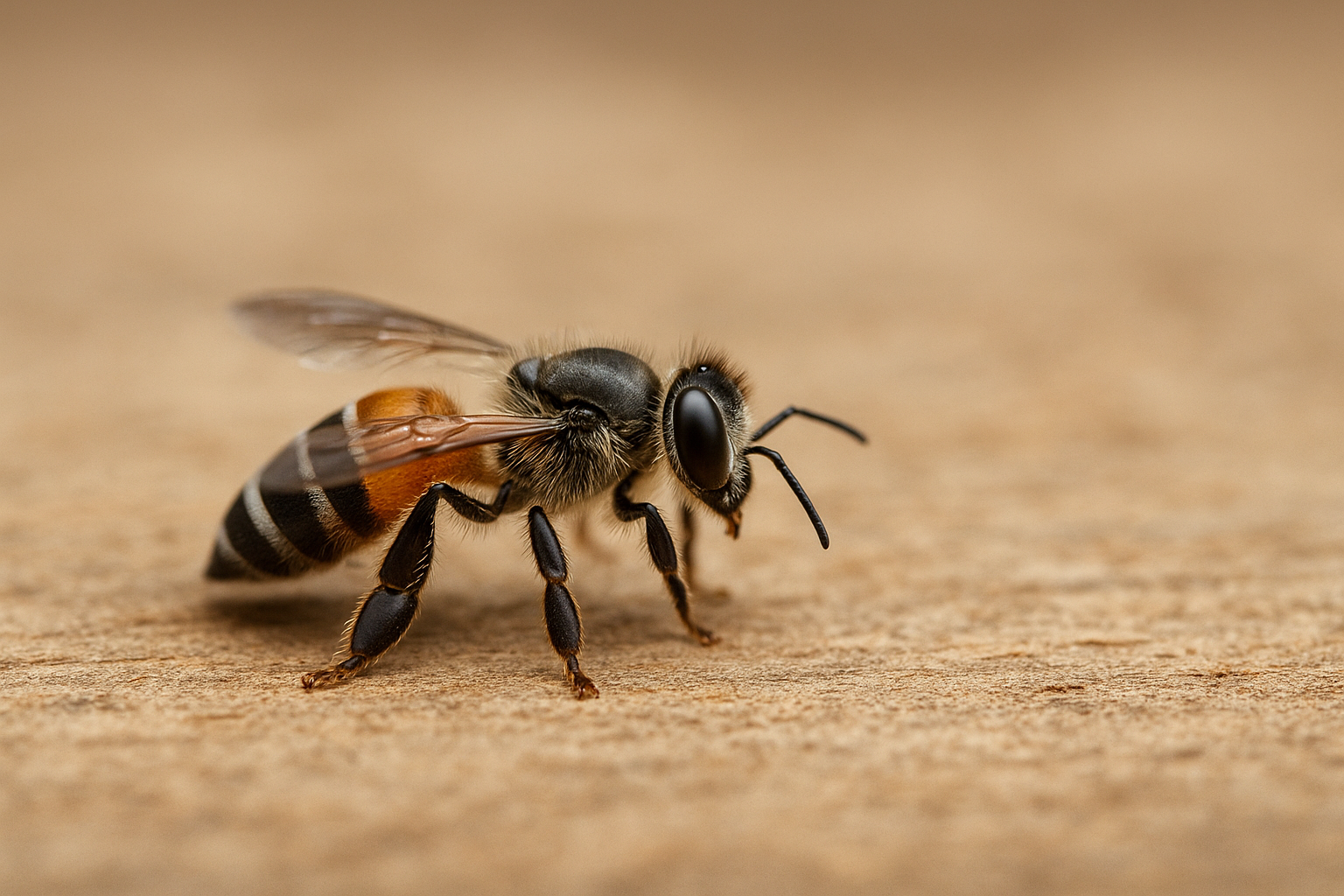
In the dappled shade of Southeast Asian shrublands, far beneath the soaring fortresses of their giant cousins, a miniature kingdom thrives with architectural precision. Apis florea—the Dwarf Honey Bee—represents one of the most basal lineages of the genus Apis. Measuring only a few millimeters, these tiny architects eschew the safety of hollows, choosing instead to suspend a single, palm-sized comb from a solitary branch. Within this “minimalist hive” lies the ancestral blueprint of bee society: the most primitive and purest form of the dance language.
📊 Data Profile: Apis florea
- Scientific Name: Apis florea (Fabricius, 1787)
- Common Name: Dwarf Honey Bee / Little Honey Bee
- Body Size: 7–10 mm (The “Smallest” of the common Apis)
- Nesting Style: Single open-air comb wrapped around a branch
- Communication: Basal horizontal waggle dance
- Defensive Strategy: Resin barriers (“Sticky Bands”) against ants
To observe Apis florea is to witness the origins of cognitive mapping, a living fossil that continues to point directly toward the sun to tell its story.
🐝 Table of Contents
- 💃 1. The Horizontal Stage — The Ancestral Dance Language
- 🛡️ 2. Chemical Moats — The Strategic Use of Resin
- 📐 3. Miniature Engineering — Efficiency in a Single Comb
- 🌺 4. Understory Specialists — Pollination of the Micro-flora
- ✨ A Poetic Reflection
💃 1. The Horizontal Stage — The Ancestral Dance Language
While advanced honeybees perform their waggle dance on vertical surfaces, translating the sun’s position into gravity-based vectors, Apis florea maintains a more direct approach.
- Direct Orientation: They perform their dance on the flat, horizontal top of the comb. By maintaining a direct line of sight to the sky, they point their bodies exactly toward the floral resource.
- Cognitive Simplicity: This horizontal orientation is considered the evolutionary precursor to the more abstract “vertical translation” used by cavity-nesting bees, representing a bridge between simple orientation and complex symbolic language.
🛡️ 2. Chemical Moats — The Strategic Use of Resin
For a bee that nests in the open, ground-based predators like ants pose a lethal threat. Apis florea has developed a physical-chemical defense to secure its home.
- Sticky Barriers: They collect sticky plant resins and apply “bands” around the branch on either side of the nest. These act as biological flypaper, preventing ants from reaching the comb.
- Maintenance: Workers constantly tend to these barriers, ensuring the resin remains tacky—a clear demonstration of behavioral specialization for nest security.
📐 3. Miniature Engineering — Efficiency in a Single Comb
Despite its small size, the Apis florea comb is a marvel of resource management. A single comb serves as a nursery, a larder, and a communication hub simultaneously.
- Honey Crown: Honey is stored in the upper section that wraps around the branch, providing structural stability and a central energy reserve.
- Thermodynamics: The open structure allows for rapid cooling in tropical heat, though it leaves the colony vulnerable to sudden temperature drops, restricting their range to warmer lowlands.
🌺 4. Understory Specialists — Pollination of the Micro-flora
As specialists of the forest understory, Apis florea provides essential pollination services for micro-flora that are often overlooked by larger pollinators. Their ability to navigate dense, tangled vegetation allows them to monopolize niche floral rewards.
By sustaining the genetic diversity of the forest floor, these miniature architects maintain the foundation of the ecosystem, ensuring that even the smallest bloom has its place in the ledger of life.
✨ A Poetic Reflection
A microcosm suspended from a slender twig—a sanctuary of primal language, pointing forever at the sun.
🐝→ Next Post (Apis 9: The Shadow Gatherers)
🐝← Previous Post (Apis 7: The Dark Bees of High Altitudes)
🐝→ Back to Series: The Apis Records
コメント