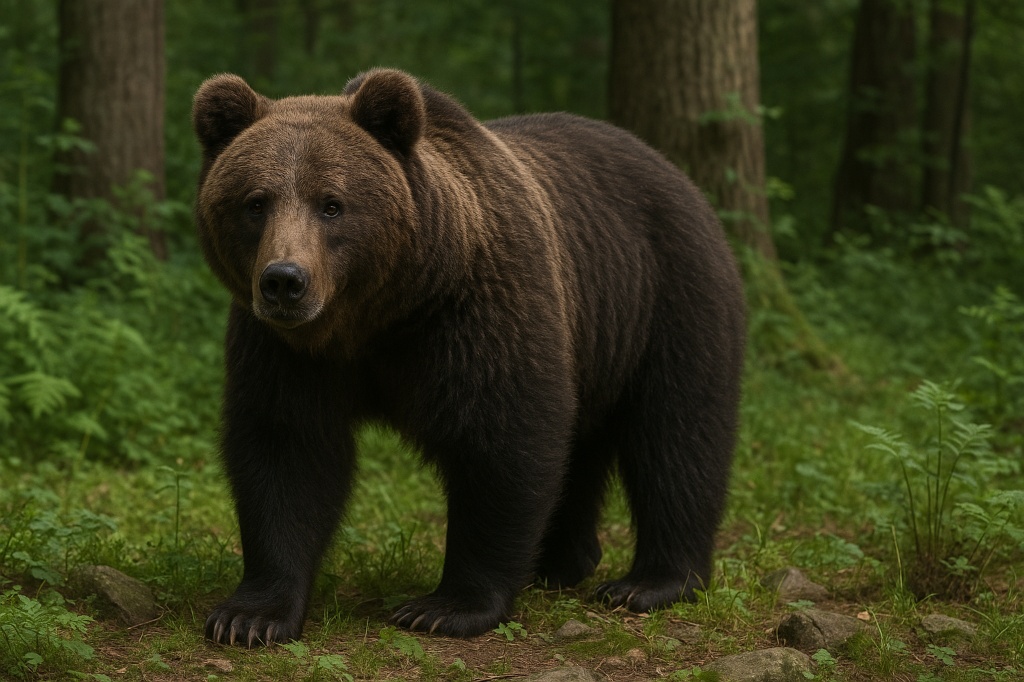
There is a presence that can alter the very atmosphere of a forest without breaking its silence. Bears embody the “Wilderness” itself—a primal state of nature that humanity has largely surrendered in exchange for civilization.
They do not roar without cause, nor do they flaunt their power unnecessarily. Their mere existence defines the territory they inhabit. A bear is an overwhelming mass hidden within stillness; a paradox of raw strength and careful deliberation.
Biologically, bears belong to the family Ursidae within the order Carnivora. From the frozen reaches of the Arctic to the tropical rainforests of South America, they have adapted to the Earth’s most demanding environments. Their massive frames, extraordinary olfactory senses, and keen intelligence are the refined results of millions of years of evolution.
Beyond being apex predators, bears serve as “keystone species” that nurture the forest and drive the rhythm of the ecosystem. To understand the bear is to listen to the deepest, most powerful heartbeat of our planet.
🐻 Table of Contents
- 🌲 1. Defining the Bear — The Peak of Versatility
- 🧬 2. Origins of Ursidae — A Unique Evolutionary Path
- 🌍 3. Walking the Earth — Diverse Habitats
- 🦴 4. Design for Survival — Majesty through Adaptability
- 🐾 A Poetic Reflection
🌲 1. Defining the Bear — The Peak of Versatility
While bears are among the largest terrestrial carnivorans, their true strength lies in their “generalist” nature—the ability to be whatever the environment demands.
- Classification: Family Ursidae, Order Carnivora.
- Locomotion: Plantigrade (walking with heels flat on the ground). This allows for stable bipedal standing and exceptional manual dexterity with their forepaws.
- Senses: An olfactory sense so acute it is often said they “see the world through their nose.” It is several times—and in some species, over ten times—stronger than that of a dog.
- Intelligence: Exceptional spatial memory and complex problem-solving skills. Documented cases even include the basic use of tools.
They possess the raw power of a hunter, yet they can pivot their survival strategy to rely on seasonal fruits, insects, or even carrion. This willingness to “abandon specialization” is exactly what made them world-class survivors.
🧬 2. Origins of Ursidae — A Unique Evolutionary Path
The history of bears traces back over 30 million years to a common ancestor shared with canids (dogs). Having blazed their own trail, the family has converged into just eight extant species today.
- Ursinae: The primary group including Brown bears, Black bears, and Polar bears.
- Tremarctinae: The Spectacled bear of South America, the last descendant of the ancient “Short-faced bears.”
- Ailuropodinae: The Giant Panda—a specialized outlier that chose a life centered on bamboo.
Bears have continuously reshaped their forms and diets to meet the shifting challenges of the Earth’s climate throughout the ages.
🌍 3. Walking the Earth — Diverse Habitats
While often associated with the Northern Hemisphere, the reach of the bear is surprisingly vast.
- Polar Regions: The Polar bear, waiting patiently for prey atop ice floes in temperatures of -40°C.
- Temperate & Boreal Zones: Brown and American Black bears that claim vast forests as their home ranges.
- Tropical Zones: The Sun bear, an arboreal specialist that feasts on ants and honey in the heat of the rainforest.
They do not merely inhabit these lands; they maintain them by dispersing seeds and cycling nutrients, acting as stewards of the wild.
🦴 4. Design for Survival — Majesty through Adaptability
The most striking aspect of a bear’s anatomy is its “balance.” They are neither the fastest nor the most specialized, yet they possess the power to both destroy and build.
- Forepaw Function: Versatile claws capable of flipping heavy boulders yet delicate enough to pluck individual berries.
- Memory Banks: The ability to remember a bountiful food source for years, returning precisely when the season is most favorable.
- The Miracle of Hibernation: A staggering physiological mechanism where they suspend active life during winter, only to awaken with the arrival of spring.
The beauty of a bear does not stem from a sharpened, singular edge, but from a profound “inclusivity” of ability. This is the true source of the awe they inspire in us.
🐾 A Poetic Reflection
In the footprint left by a bear, one can read the true depth and richness of the forest itself.
🐻→ Next Post (Bear 2: Evolution and Lineage)
🐻→ Back to Series: Bears

コメント