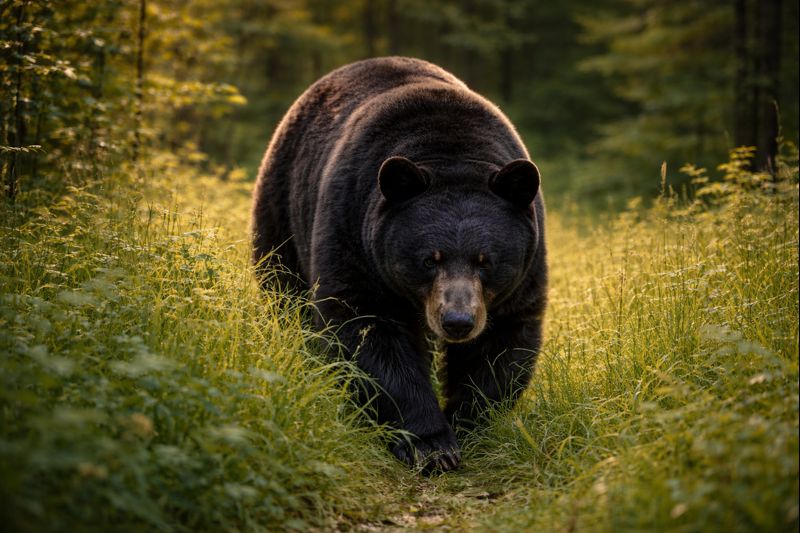
| Basic Species Profile | |
|---|---|
| Scientific Name | Ursus americanus |
| Common Names | American Black Bear |
| Primary Habitat | Dense forests, mountains, and increasingly, suburban interfaces. |
| Mass (Adult Male) | 60 kg – 250 kg (Exceptional cases up to 400 kg) |
| Color Variations | Black, brown (cinnamon), blonde, and even white (Kermode). |
| Conservation Status | Least Concern (Stable/Increasing in many regions). |
The American Black Bear is the most common bear species in North America, and perhaps the world’s greatest student of coexistence. Unlike their larger cousins, the Brown bears, Black bears have thrived by mastering the art of the “forest edge”—utilizing vertical space and a flexible temperament to survive in landscapes heavily altered by humans.
To call them merely “black” is a misnomer; they are a species defined by chromatic diversity and a psychological resilience that allows them to live from the swamps of Florida to the subarctic forests of Alaska. They are the silent, climbing ghosts of the American woods.
🐻 Table of Contents
- 🌲 1. Vertical Refuge — The Anatomy of a Climber
- 🎨 2. The Color Paradox — Why Black Bears Aren’t Always Black
- 🏙️ 3. Suburban Specialists — Intelligence in the Anthropocene
- 🛡️ 4. Temperament vs. Myth — The “Shy” Predator
- 🐾 A Poetic Reflection
🌲 1. Vertical Refuge — The Anatomy of a Climber
While Brown bears dominate the ground, the American Black Bear dominates the trees. Their entire physical build is optimized for vertical movement as a primary defense mechanism.
- Curved Claws: Their claws are shorter and more sharply curved than a Grizzly’s, acting like climbing spikes that can easily hook into bark.
- Upper Body Strength: They possess a power-to-weight ratio that allows even large adults to scramble up a trunk in seconds—a behavior essential for cubs to escape predators.
- Arboreal Foraging: They often feed in the canopy, utilizing a flexibility in their limbs that allows them to reach fruit and nuts that heavier bears cannot access.
🎨 2. The Color Paradox — Why Black Bears Aren’t Always Black
The name Ursus americanus covers a spectrum of colors that often leads to misidentification with Brown bears.
- Cinnamon and Blonde: In western North America, open-canopy forests favor lighter coats to reduce heat absorption. Cinnamon-colored Black bears are frequently mistaken for Grizzlies.
- The Spirit Bear (Kermode): On the coast of British Columbia, a recessive gene produces white-coated individuals. These are not albinos but a unique color phase revered by Indigenous cultures.
- The Glacier Bear: A rare blue-gray variant found in Southeast Alaska, adapted to the shadows of the coastal fjords.
🏙️ 3. Suburban Specialists — Intelligence in the Anthropocene
Black bears are currently undergoing a massive range expansion, often moving *toward* human settlements rather than away from them.
- Opportunistic Foraging: They have learned to navigate suburban environments, memorizing “trash pick-up days” and identifying bird feeders as high-calorie rewards.
- Nocturnal Shifting: In areas with high human activity, Black bears often become more nocturnal to avoid direct contact, showcasing their ability to alter their biological rhythms for safety.
- Problem Solving: Their ability to open car doors, slide windows, and bypass complex latches is a testament to the cognitive complexity discussed in Chapter 8.
🛡️ 4. Temperament vs. Myth — The “Shy” Predator
Despite their strength, Black bears are naturally more timid than Brown bears. Their primary instinct when confronted is flight—specifically upward.
- Evolutionary Caution: Having evolved alongside larger predators like the American Lion and the Grizzly, Black bears developed a strategy of avoidance rather than confrontation.
- Maternal Strategy: Unlike Grizzly mothers who charge to defend cubs, Black bear mothers typically send their cubs up a tree and may even lead a predator away from the site.
- Human Conflict: Most injuries to humans occur when a bear is cornered or “food-conditioned,” losing its natural fear of people in exchange for easy calories.
🐾 A Poetic Reflection
The Black Bear is a shadow that has learned to climb, a quiet neighbor who watches from the canopy as the world below forgets its own wildness.
🐻→ Next Post (Bear 15: The Asiatic Black Bear)
🐻← Previous Post (Bear 13: The Brown Bear)
🐻🏠 Series Overview: Bears
コメント