| Basic Species Profile | |
|---|---|
| Scientific Name | Ursus thibetanus |
| Common Names | Asiatic Black Bear, Moon Bear, Tibetan Black Bear |
| Range & Habitat | Across Asia: from Iran and the Himalayas to Japan and Southeast Asia. Primarily moist broadleaf and mixed forests. |
| Mass (Adult Male) | 60 kg – 200 kg (Varies significantly by region) |
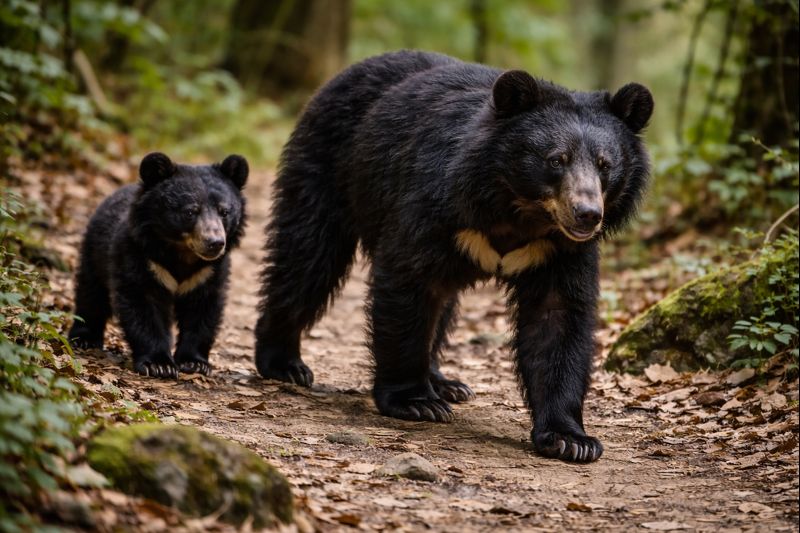
| Key Feature | Distinctive white “crescent moon” patch on the chest. |
| Conservation Status | Vulnerable (IUCN). Facing severe habitat loss and poaching. |
The Asiatic Black Bear, often called the “Moon Bear” due to the creamy white crescent on its chest, is a creature of shadows and steep terrain. While it shares a name with the American Black Bear, it is a distinct evolutionary branch, more closely related to the ancestral stock of the Brown Bear. In Asian cultures, it is often seen as a spirit of the mountains—venerated as a god by some, yet increasingly threatened by the modern world.
Living in closer proximity to human settlements than almost any other bear species, the Asiatic Black Bear is a master of the vertical world. From the snowy peaks of the Himalayas to the lush islands of Japan, they navigate the thin line between the ancient forest and the encroaching Anthropocene.
🐻 Table of Contents
- 🌙 1. The Crescent Moon — Symbolism and Function
- 🧗 2. Arboreal Masters — Life Above the Forest Floor
- 🍒 3. Dietary Preferences — The Hard Mast Specialist
- ⚠️ 4. The Human Shadow — Conflict and Conservation
- 🐾 A Poetic Reflection
🌙 1. The Crescent Moon — Symbolism and Function
The most iconic feature of Ursus thibetanus is the white V-shaped patch on its chest. While aesthetically striking, its biological purpose remains a subject of debate.
- Intraspecific Signaling: Some biologists suggest the white patch serves as a visual signal during aggressive stand-offs, making the bear appear larger and more formidable when it stands on its hind legs.
- Aposematism: Similar to the markings of other forest animals, it may serve as a warning to potential predators or rivals in the dim light of the understory.
- Morphological Variety: The shape and size of the moon patch vary by individual and subspecies; in Japanese populations, it is sometimes absent or reduced to a small spot.
🧗 2. Arboreal Masters — Life Above the Forest Floor
Compared to Brown bears, the Asiatic Black Bear is far more specialized for a life in the canopy. They are the most arboreal of the temperate bears.
- “Enza” (Bear Nests): They frequently build platforms in the trees by folding branches. These “nests” allow them to feed on acorns and nuts in the canopy safely and comfortably.
- Climbing Anatomy: Their powerful forelimbs and shorter, curved claws are perfectly adapted for gripping bark, allowing them to scale 20-meter trees with ease.
- Defense Strategy: When threatened, their first instinct is often to climb upward, seeking refuge in the high branches where larger predators cannot follow.
🍒 3. Dietary Preferences — The Hard Mast Specialist
While omnivorous, the Asiatic Black Bear is particularly dependent on “hard mast”—the seeds and nuts of forest trees.
- Nutritional Rhythm: Their year revolves around the ripening of acorns, beechnuts, and walnuts. A failure in the mast crop often leads to “mass intrusions” into human villages as they seek alternative food.
- Insectivory: They are fond of ants, bees, and wasps, using their dexterous claws to tear open rotting logs or raid hives.
- Carnivory: While they occasionally hunt small mammals or scavenge, meat makes up a smaller portion of their diet compared to Brown bears.
⚠️ 4. The Human Shadow — Conflict and Conservation
Because they inhabit the same narrow valleys and mountain foothills as human populations, the Asiatic Black Bear faces intense pressure.
- Habitat Fragmentation: Roads and dams in mountainous regions divide their territories, leading to genetic isolation and increased accidental encounters with people.
- The Bile Trade: In some parts of Asia, they are still poached or farmed for their bile, which is used in traditional medicine—a practice that remains one of the most significant ethical and conservation challenges.
- Coexistence in Japan: In Japan, the “Tsukinowaguma” is both a symbol of the mountain and a source of agricultural conflict. Management relies on sophisticated tracking and public education to prevent lethal encounters.
🐾 A Poetic Reflection
The Moon Bear carries the light of a silver crescent through the dark of the pines, a bridge between the stars and the silent earth.
🐻→ Next Post (Bear 16: The Polar Bear)
🐻← Previous Post (Bear 14: The American Black Bear)
🐻🏠 Series Overview: Bears
コメント