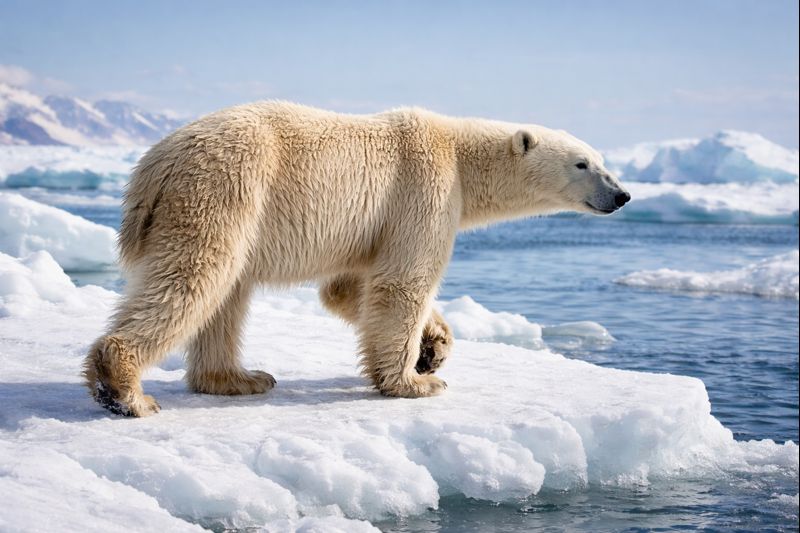
| Basic Species Profile | |
|---|---|
| Scientific Name | Ursus maritimus |
| Common Names | Polar Bear, Ice Bear, Sea Bear |
| Range & Habitat | Circumpolar Arctic; primarily sea ice, coastal islands, and continental coastlines. |
| Mass (Adult Male) | 350 kg – 700 kg (Record specimens over 1,000 kg) |
| Dietary Type | Hyper-carnivore (Specializing in Ringed and Bearded seals). |
| Conservation Status | Vulnerable (IUCN). Population declining due to sea ice loss. |
The Polar Bear is the ultimate expression of evolutionary specialization. While its cousins evolved to embrace the variety of the forest, Ursus maritimus turned its gaze toward the frozen sea. It is the only bear species classified as a marine mammal, spending the vast majority of its life on the shifting platforms of sea ice. In the Arctic, the Polar Bear is not just a predator; it is the very soul of the north.
Physiologically and behaviorally, they are built for extremes. From their translucent fur that traps the sun’s warmth to their ability to fast for months when the ice melts, every aspect of their being is a calculated response to the most inhospitable climate on Earth. However, this high degree of specialization now leaves them vulnerable to a world that is warming faster than they can adapt.
🐻 Table of Contents
- ❄️ 1. Marine Anatomy — Built for the Deep Freeze
- 🚢 2. The Ice Platform — A Life on the Move
- 🏹 3. The Stealth Hunter — Mastery of the Seal Pulse
- 🔥 4. The Melting Kingdom — Climate Change and Survival
- 🐾 A Poetic Reflection
❄️ 1. Marine Anatomy — Built for the Deep Freeze
To survive in temperatures that plummet to -50°C, the Polar Bear has undergone radical anatomical changes compared to its Brown Bear ancestors.
- Black Skin, White Fur: Their fur is actually pigment-free and translucent; it appears white because it scatters light. Beneath the fur, their skin is jet black to absorb as much solar radiation as possible.
- Blubber Layer: They possess a layer of fat up to 10 cm thick, which provides both insulation and a massive energy reserve for lean periods.
- The “Paddle” Paws: Their front paws are large and slightly webbed, used as powerful oars for swimming across open water, while the soles are covered in small bumps (papillae) for traction on slippery ice.
🚢 2. The Ice Platform — A Life on the Move
For a Polar Bear, sea ice is not just a place to stand—it is their hunting ground, their mating floor, and their primary means of travel.
- Annual Ice Cycles: They follow the “edge” of the ice (the floe edge), where biological productivity is highest. When the ice melts completely in summer, they are forced onto land, entering a state of “walking hibernation.”
- Immense Ranges: Because the ice is constantly moving with the currents, a Polar Bear’s home range can cover up to 300,000 square kilometers—the largest of any bear species.
- Long-Distance Swimmers: They are capable of swimming for days at a time, covering hundreds of kilometers between ice floes, though this is becoming increasingly dangerous as the gaps between ice sheets widen.
🏹 3. The Stealth Hunter — Mastery of the Seal Pulse
As hyper-carnivores, Polar bears are almost entirely dependent on the high-fat blubber of seals to maintain their massive bodies.
- Still-Hunting: A bear will wait for hours by a seal’s breathing hole in the ice, motionless and silent, waiting for the split second the seal surfaces.
- The Smell of Life: As discussed in Chapter 4, their sense of smell can detect a seal from 30 km away, even if the prey is buried under a meter of snow.
- The Caloric Math: A Polar Bear needs to catch approximately one seal per week to stay healthy. A single successful hunt of a large bearded seal can provide enough energy for weeks.
🔥 4. The Melting Kingdom — Climate Change and Survival
The Polar Bear has become the global symbol for the climate crisis, and for good reason: their habitat is physically disappearing.
- Shortening Hunting Seasons: As the ice melts earlier in the spring and freezes later in the autumn, bears have less time to hunt and build the fat reserves needed to survive the summer fast.
- Nutritional Stress: Low body weight leads to lower reproductive rates and higher cub mortality. In some populations, such as the Western Hudson Bay, numbers have plummeted significantly.
- Human-Polar Bear Conflict: As they grow hungrier, bears are increasingly venturing into Arctic towns like Churchill, Canada, seeking food, leading to dangerous encounters.
🐾 A Poetic Reflection
The Polar Bear is a ghost of the ice, a white shadow moving through a kingdom that is quietly turning back into water.
🐻→ Next Post (Bear 17: The Sun Bear)
🐻← Previous Post (Bear 15: The Asiatic Black Bear)
🐻🏠 Series Overview: Bears
コメント