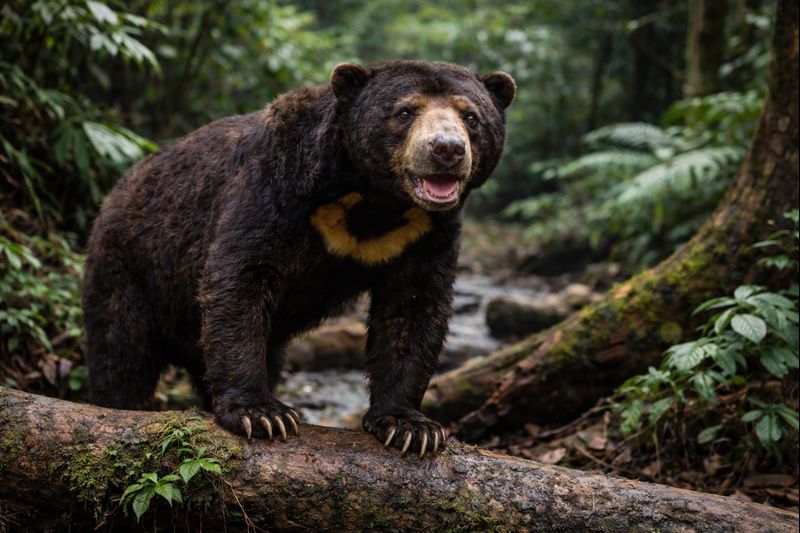
| Basic Species Profile | |
|---|---|
| Scientific Name | Helarctos malayanus |
| Common Names | Sun Bear, Honey Bear, Dog Bear |
| Range & Habitat | Southeast Asia: Mainland and islands (Borneo, Sumatra). Tropical rainforests and swamps. |
| Mass (Adult Male) | 30 kg – 70 kg (World’s smallest bear species) |
| Unique Feature | Extremely long tongue (up to 25 cm) and loose, thick skin. |
| Conservation Status | Vulnerable (IUCN). Rapidly losing habitat to oil palm plantations. |
The Sun Bear is a creature of extremes and contradictions. As the smallest member of the bear family, it lacks the sheer mass of its northern cousins but compensates with an intensity of adaptation that is unparalleled. Named for the golden-orange crescent on its chest that resembles a rising sun, this bear is a master of the vertical jungle, spending its life in the humid canopy of Southeast Asia’s most ancient rainforests.
Unlike temperate bears, the Sun Bear does not hibernate. Living in a world of perpetual summer, its life is a constant cycle of foraging and engineering. From its impossibly long tongue designed to raid bee hives to its formidable jaw strength, Helarctos malayanus is a specialized tool for survival in a high-density, competitive ecosystem.
🐻 Table of Contents
- 👅 1. The Honey Specialist — The Anatomy of a Hive Raider
- 🏗️ 2. Forest Engineers — The Impact of a Tearing Claw
- 🛡️ 3. Defensive Flexibility — Survival Against Tigers
- 🌴 4. The Palm Oil Threat — A Vanishing Green Kingdom
- 🐾 A Poetic Reflection
👅 1. The Honey Specialist — The Anatomy of a Hive Raider
The Sun Bear’s alternative name, the “Honey Bear,” is well-earned. Their entire morphology is focused on extracting high-calorie snacks from inaccessible places.
- The 25-cm Tongue: They possess the longest tongue of any bear species, allowing them to extract honey and larvae from deep within tree hollows and termite mounds.
- Jaw Strength: Despite their small size, they have a bite force that is proportionally enormous. This allows them to tear through solid hardwood to reach the insects nesting inside.
- Non-Hibernating Metabolism: Since food is available year-round, they have no biological trigger for torpor, maintaining an active metabolism throughout the year.
🏗️ 2. Forest Engineers — The Impact of a Tearing Claw
In the ecology of the rainforest, the Sun Bear plays the role of a destructive yet vital architect.
- Nutrient Recycling: By tearing apart rotting logs to find beetle larvae, they accelerate the decomposition process, returning nutrients to the soil.
- Creating Homes: The cavities they excavate in trees often become nesting sites for birds (like hornbills) and small mammals, making them a keystone species for forest biodiversity.
- Seed Dispersal: They consume a wide variety of tropical fruits, and like their cousins, they play a critical role in “planting” the forest as they move.
🛡️ 3. Defensive Flexibility — Survival Against Tigers
Being small in a jungle full of tigers and leopards requires a unique defensive strategy. The Sun Bear’s skin is its primary shield.
- Loose Skin: Their skin is remarkably loose. If a predator like a tiger grabs them by the neck, the bear can literally turn around within its own skin to bite and claw its attacker.
- Aggressive Temperament: They are known as one of the most aggressive bear species when startled. This “fearless” reputation is a necessary bluff for a smaller animal living among giants.
🌴 4. The Palm Oil Threat — A Vanishing Green Kingdom
The Sun Bear is currently facing one of the fastest rates of habitat loss in the world.
- Monoculture Deserts: The conversion of primary rainforests into oil palm plantations destroys the complex vertical habitat the Sun Bear requires to survive.
- Illegal Trade: Cubs are frequently captured for the pet trade, and adults are killed for their gallbladders and paws, driven by persistent demand in illegal wildlife markets.
- Conservation Efforts: Organizations like the BSBCC in Borneo are working to rehabilitate rescued bears, but the long-term survival of the species depends on the preservation of large, contiguous forest tracts.
🐾 A Poetic Reflection
Small enough to hide in the canopy, yet fierce enough to hold the sun upon its chest, the bear remains the secret pulse of the emerald forest.
🐻→ Next Post (Bear 18: The Sloth Bear)
🐻← Previous Post (Bear 16: The Polar Bear)
🐻🏠 Series Overview: Bears
コメント