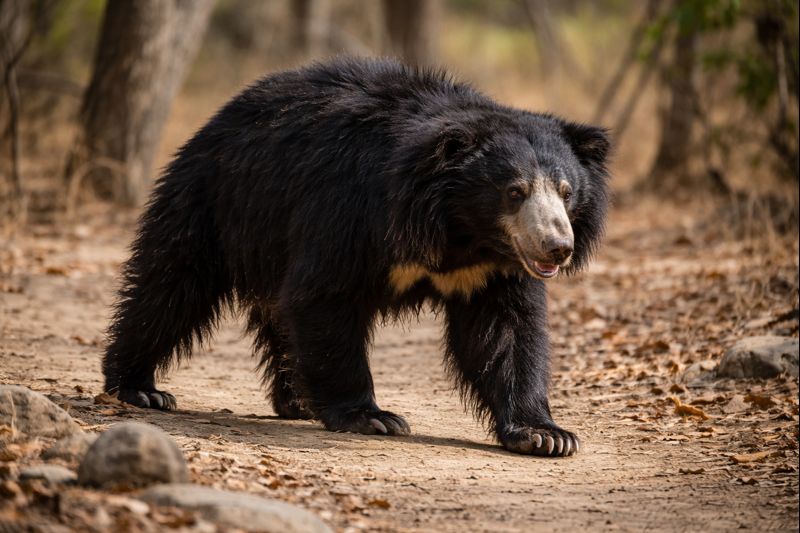
| Basic Species Profile | |
|---|---|
| Scientific Name | Melursus ursinus |
| Common Names | Sloth Bear, Labiated Bear |
| Range & Habitat | Indian Subcontinent (India, Sri Lanka, Nepal, Bhutan). Lowland forests and grasslands. |
| Mass (Adult Male) | 80 kg – 145 kg (Exceptional specimens up to 190 kg) |
| Unique Adaptation | Missing upper central incisors and flexible, protrusible lips. |
| Conservation Status | Vulnerable (IUCN). Habitat loss and conflict with growing human populations. |
The Sloth Bear is perhaps the most anatomically eccentric member of the bear family. When early European naturalists first saw its long, shaggy coat and sickle-shaped claws, they mistakenly classified it as a species of sloth. However, far from being slow, the Sloth Bear is an agile, high-energy specialist that has evolved to occupy a very specific niche: the ultimate consumer of social insects.
Found primarily in the diverse landscapes of India and Sri Lanka, Melursus ursinus has traded the traditional dental structure of a carnivore for a “biological vacuum cleaner” system. Their life is a loud, dusty, and persistent pursuit of termites and honey, governed by a temperament that is famously defensive and unpredictable.
🐻 Table of Contents
- 🐜 1. The Suction Strategy — Anatomy of a Vacuum
- 🧥 2. The Shaggy Shield — Survival in Tiger Territory
- 🍯 3. The Baloo Factor — Diet and Nocturnal Habits
- ⚔️ 4. A Dangerous Coexistence — The Human-Bear Conflict
- 🐾 A Poetic Reflection
🐜 1. The Suction Strategy — Anatomy of a Vacuum
The Sloth Bear is a master of myrmecophagy (eating ants and termites). Their skull and mouth have been radically reshaped to facilitate this.
- Missing Incisors: They lack their two upper middle incisors. This creates a permanent gap—a “nozzle”—through which they can suck up insects.
- Flexible Lips and Nostrils: Their lips are long and highly mobile (protrusible), allowing them to form a seal against a termite mound. They can also voluntarily close their nostrils to keep out dust and biting insects.
- The Acoustic Hunter: The sound of a Sloth Bear feeding can be heard over 100 meters away; they use powerful suction to pull thousands of termites through their dental gap like a vacuum cleaner.
🧥 2. The Shaggy Shield — Survival in Tiger Territory
Unlike many other bears, Sloth bears evolved alongside two of the world’s most formidable predators: the Bengal Tiger and the Indian Leopard.
- Defensive Aggression: Because they cannot easily outrun a tiger, Sloth bears have developed a “best defense is a good offense” strategy. They are known to charge and stand their ground against tigers twice their size.
- Shaggy Mane: Their long, coarse fur is not for warmth (in the heat of India) but likely serves as a protective barrier, making it difficult for a predator to get a lethal grip on their neck or back.
- Piggyback Rearing: Sloth bears are the only bear species where the mother regularly carries her cubs on her back. This keeps the cubs safe from ground predators and allows the mother to flee or fight with her offspring securely attached.
🍯 3. The Baloo Factor — Diet and Nocturnal Habits
While termites are their staple, Sloth bears are deeply opportunistic, a trait famously captured in Rudyard Kipling’s The Jungle Book.
- Frugivory: They are obsessed with sugar. During the fruiting season of the Mahua tree, Sloth bears will travel great distances to feast on the fermenting flowers and fruit.
- Honey Raiders: Using their 4-inch curved claws, they easily climb trees to raid wild honeybee nests, ignoring the stings thanks to their thick, shaggy fur.
- Night Vision: While they can be active during the day, they are primarily nocturnal or crepuscular, using the cooler hours to forage across the hot Indian plains.
⚔️ 4. A Dangerous Coexistence — The Human-Bear Conflict
In many parts of India, Sloth bears are feared more than tigers. This is due to their poor eyesight and hearing, combined with an explosive defensive reflex.
- Surprise Encounters: Because they don’t always detect humans until they are very close, Sloth bears often react with an immediate, violent charge to neutralize the “threat.”
- Habitat Encroachment: As forest edges are converted to farmland, Sloth bears are increasingly coming into contact with villagers, leading to high rates of conflict and injury.
- Conservation Status: Once used as “dancing bears” for entertainment, the species is now protected, but their future depends on finding a way for people and bears to share the fragmented Indian landscape.
🐾 A Poetic Reflection
With a mane of tangled shadows and a mouth that breathes in the earth’s small secrets, the bear remains a defiant ghost on the tiger’s path.
🐻→ Next Post (Bear 19: The Spectacled Bear)
🐻← Previous Post (Bear 17: The Sun Bear)
🐻🏠 Series Overview: Bears


コメント