| Basic Species Profile | |
|---|---|
| Scientific Name | Ailuropoda melanoleuca |
| Common Names | Giant Panda, Bamboo Bear |
| Range & Habitat | Sichuan, Shaanxi, and Gansu provinces, China. High-altitude montane bamboo forests. |
| Mass (Adult Male) | 85 kg – 125 kg (Females are slightly smaller) |
| Primary Diet | 99% Bamboo (Stems, shoots, and leaves). |
| Conservation Status | Vulnerable (IUCN). Upgraded from “Endangered” in 2016. |
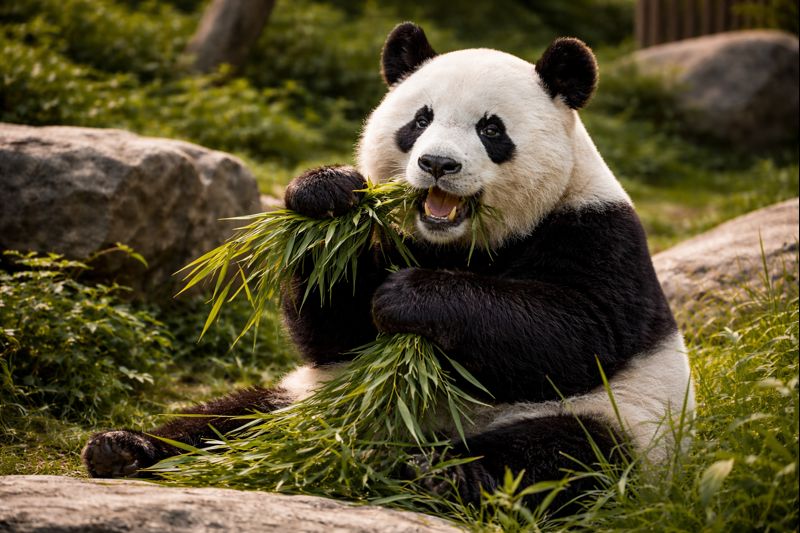
The Giant Panda is a walking contradiction. Taxonomically, it is a bear and a member of the order Carnivora, yet it spends 14 hours a day consuming a plant that offers almost no nutritional value. It is the most ancient lineage of the bear family, having diverged from the main branch nearly 19 million years ago to follow a path of extreme specialization.
Living in the mist-shrouded mountains of central China, Ailuropoda melanoleuca has traded the aggressive dominance of its cousins for a life of quiet efficiency. To survive on bamboo, the panda had to rewire its anatomy, its metabolism, and even its daily schedule. It is a masterpiece of evolutionary niche-filling—a predator that chose to become a monk.
🐻 Table of Contents
- 🦴 1. The Sixth Digit — The Engineering of the Radial Sesamoid
- 🧪 2. The Carnivore’s Gut — The Inefficiency of Bamboo
- 🎨 3. Bipolar Camouflage — The Purpose of the Monochrome Coat
- 🎋 4. The Vulnerable Zen — Conservation of the High Peaks
- 🐾 A Poetic Reflection
🦴 1. The Sixth Digit — The Engineering of the Radial Sesamoid
One of the most famous examples of convergent evolution is the panda’s “thumb,” which allows it to handle bamboo with the dexterity of a primate.
- The “Pseudo-Thumb”: This is not a true finger but an enlarged radial sesamoid (wrist bone). It provides a firm surface against which the other five digits can grip bamboo stalks.
- Cranial Strength: To crush tough bamboo fibers, the panda has developed massive jaw muscles (the masseter) and a high sagittal crest on its skull, giving it a bite force rivaling the Polar Bear.
- Precision Foraging: This anatomical toolkit allows the panda to peel away the hard outer layer of a bamboo shoot to reach the nutrient-dense core with surgical efficiency.
🧪 2. The Carnivore’s Gut — The Inefficiency of Bamboo
Unlike cows or horses, pandas do not have a specialized stomach for digesting cellulose. They are essentially meat-eaters trying to live on grass.
- The Short Plumbing: A panda’s digestive tract is short, typical of a carnivore. They only digest about 17-20% of the bamboo they eat.
- Volume as Strategy: To compensate for this inefficiency, they consume staggering amounts of bamboo—up to 12 to 38 kg per day—passing the fiber through their system rapidly.
- Metabolic Suppression: To save energy, pandas have lower thyroid hormone levels than typical mammals of their size. They move slowly and avoid unnecessary social interactions to conserve every calorie.
🎨 3. Bipolar Camouflage — The Purpose of the Monochrome Coat
The panda’s striking black-and-white pattern was long a mystery. Recent studies suggest it serves a dual purpose in their varied mountain environment.
- Dual Concealment: The white parts of the body help them hide in snowy landscapes, while the black limbs and ears provide camouflage in the deep shadows of the forest understory.
- Eye Patches: These may function in social signaling, helping pandas recognize one another or appearing as “large eyes” to deter predators when the panda is resting.
🎋 4. The Vulnerable Zen — Conservation of the High Peaks
The Giant Panda is the global face of wildlife conservation, and its recent population rebound is a rare success story.
- The “Umbrella” Species: By protecting the bamboo forests required by pandas, China has inadvertently protected hundreds of other species, including the Red Panda and the Golden Snub-nosed Monkey.
- Bamboo Flowering: A unique threat to pandas is the “mass flowering” of bamboo, where an entire species dies off simultaneously once every few decades. Without “corridors” to other bamboo patches, pandas can face localized famine.
- Climate Resilience: As temperatures rise, the narrow altitudinal band where bamboo thrives is shifting upward, making the preservation of high-altitude habitats more critical than ever.
🐾 A Poetic Reflection
A carnivore with the heart of a forest, the panda sits in the silence of the bamboo, turning the world’s toughest wood into the gentlest of lives.
🐻→ Next Post (Bear 21: Bears of the Ice Age)
🐻← Previous Post (Bear 19: The Spectacled Bear)
🐻🏠 Series Overview: Bears

コメント