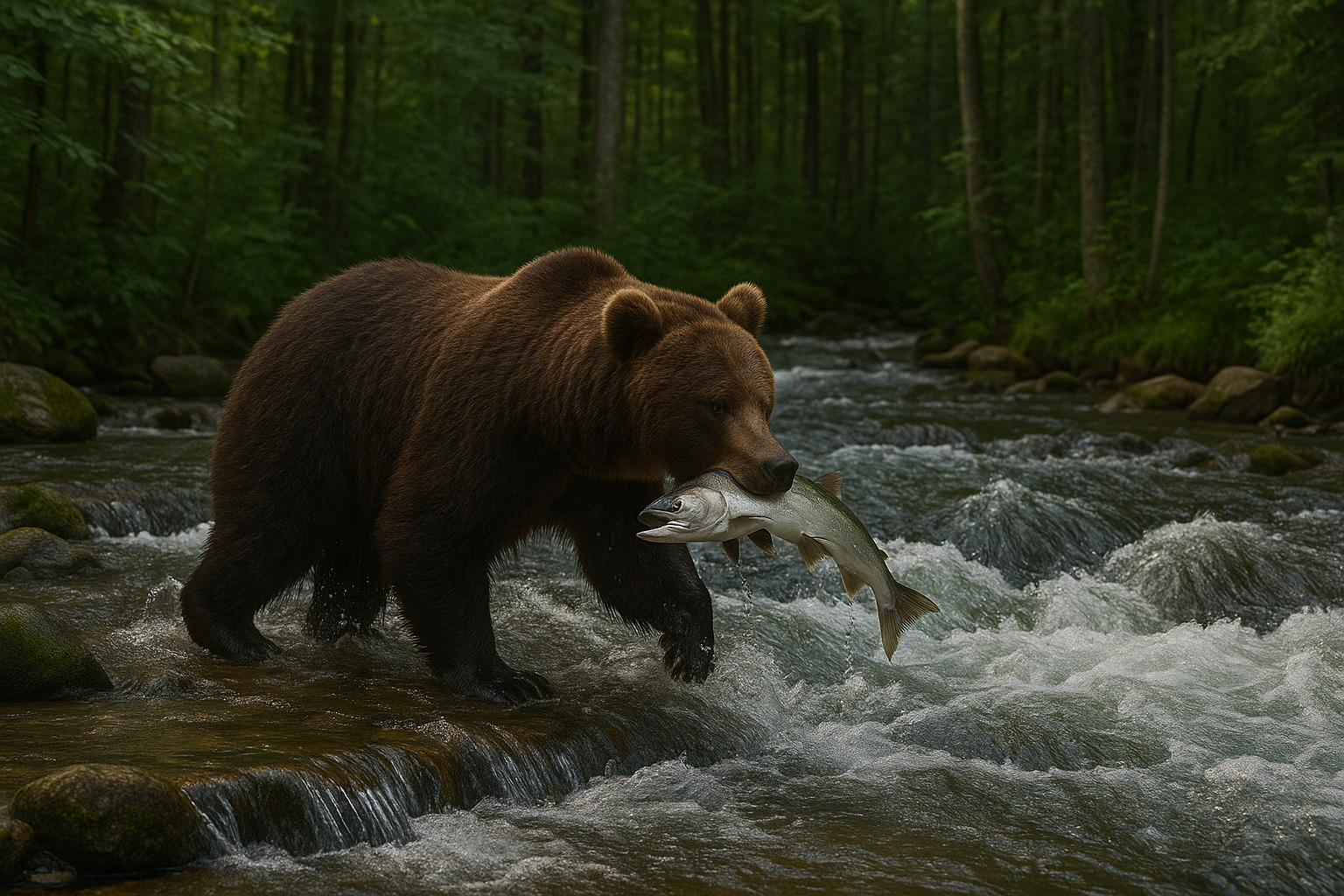
Bears are classified under the order Carnivora, yet with the exception of the Polar Bear, they are some of the most versatile omnivores on the planet. This transition from a pure meat-eater to an opportunistic generalist is not a sign of evolutionary weakness, but a masterstroke of survival strategy.
By breaking the “carnivore code,” bears unlocked the ability to inhabit almost any landscape. They are the ultimate pragmatists of the animal kingdom, following the calendar of the earth rather than the movements of a single prey species. To a bear, the world is an all-you-can-eat buffet that changes with the seasons.
🐻 Table of Contents
- 🥩 1. The Carnivore’s Dilemma — The Shift to Omnivory
- 🍓 2. Seasonal Specialists — Following the Nutritional Clock
- 🧪 3. The Digestive Compromise — Processing Plants with a Carnivore Gut
- ⚖️ 4. The Benefit of Being a Generalist — Resilience in a Changing World
- 🐾 A Poetic Reflection
🥩 1. The Carnivore’s Dilemma — The Shift to Omnivory
While their ancestors were hunters, modern bears (Ursids) realized that relying solely on meat is a high-risk gamble. Hunting requires immense energy and carries the constant threat of injury or failure.
- Energy Efficiency: Grazing on clover or stripping a berry bush provides a steady, low-risk caloric intake compared to the high-stakes chase of an elk.
- Dental Evidence: Bear molars have evolved to be flat and broad (bunodont), perfect for grinding fibrous vegetation, while keeping their sharp canines for defense and occasional kills.
- The Exception: The Polar Bear remains a hyper-carnivore due to the lack of vegetation in the Arctic, proving that bears can revert to pure carnivory if the environment demands it.
🍓 2. Seasonal Specialists — Following the Nutritional Clock
A bear’s diet is a map of the seasons. They possess a “nutritional memory” that allows them to be in the right place at the right time.
- Spring: Focusing on high-protein emerging grasses, sedges, and winter-killed carcasses to jumpstart their metabolism after hibernation.
- Summer: The season of insects and early fruits. Sloth bears and Sun bears specialize in high-fat larvae and termites during this period.
- Autumn (Hyperphagia): A frantic search for “hard mast” like acorns, pine nuts, and salmon. This is the critical window for building the fat reserves necessary for winter survival.
🧪 3. The Digestive Compromise — Processing Plants with a Carnivore Gut
Interestingly, bears do not possess the multi-chambered stomachs or long intestines of true herbivores like cows or deer. They are processing plants using the “short plumbing” of a meat-eater.
- Speed over Efficiency: Because they cannot digest cellulose efficiently, bears compensate by eating massive quantities of food, passing it through their system quickly to extract the easiest nutrients.
- Microbiome Adaptation: Recent studies show that a bear’s gut bacteria shift dramatically between summer (plant-heavy) and winter (fasting), aiding in the processing of different food types.
⚖️ 4. The Benefit of Being a Generalist — Resilience in a Changing World
In ecology, “specialists” are the first to suffer when an environment changes. The bear’s ability to pivot its diet makes it incredibly resilient.
- Ecological Engineers: By consuming vast amounts of fruit and salmon, bears act as seed dispersers and nutrient transporters, literally fertilizing the forest floor with their waste.
- Urban Adaptability: In the modern world, this opportunism leads them to human food sources (trash, orchards), creating a complex challenge for coexistence.
🐾 A Poetic Reflection
The bear does not demand the world be a certain way; it simply accepts the gift of the season, whether it be a silver salmon or a single, sun-ripened berry.
🐻→ Next Post (Bear 6: The Physiology of Survival)
🐻← Previous Post (Bear 4: A World of Scents)
🐻🏠 Series Overview: Bears


コメント