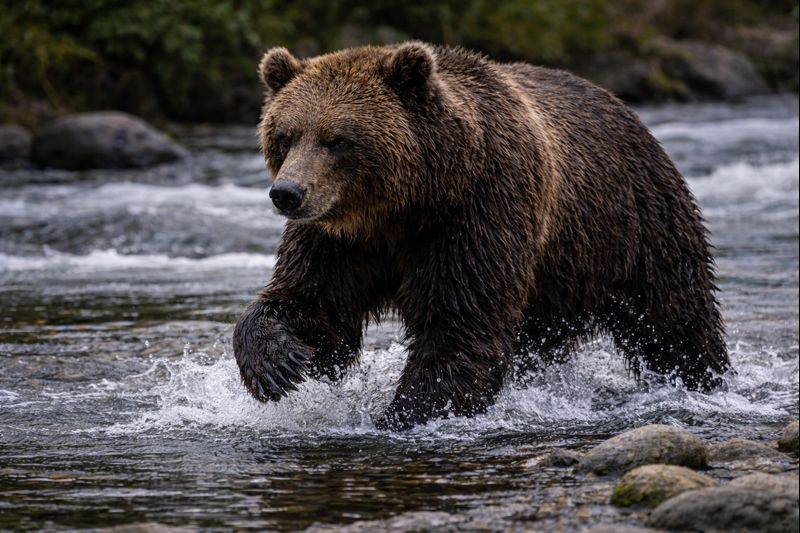
For decades, the intelligence of bears was vastly underestimated, often overshadowed by their raw physical power. However, modern ethology reveals a different reality: bears possess some of the most sophisticated cognitive abilities in the animal kingdom. They do not merely react to their environment; they analyze, remember, and manipulate it to their advantage.
With a brain-to-body mass ratio that rivals some primates, bears are masters of problem-solving. Their survival depends not just on strength, but on their ability to learn from experience and adapt to new challenges in an ever-changing landscape. To encounter a bear is to meet a mind that is constantly calculating its next move.
🐻 Table of Contents
- 🧠 1. The Architecture of Intelligence — Brain Size and Structure
- 🕵️ 2. Problem Solving and Tool Use — Innovation in the Wild
- 📚 3. Exceptional Memory — The Long-Term Navigator
- 🎓 4. Social Learning — Knowledge Passed Through Generations
- 🐾 A Poetic Reflection
🧠 1. The Architecture of Intelligence — Brain Size and Structure
A bear’s intelligence is rooted in a highly developed cerebral cortex, the area of the brain associated with complex thought and decision-making.
- Encephalization Quotient: While not as high as humans or dolphins, bears have one of the largest brains relative to body size among all carnivorans.
- Cerebral Folding: The bear’s brain exhibits significant convolution (folding), which increases the surface area for neural processing, aiding in high-level sensory integration.
- Focus on Flexibility: Their neural pathways are wired for “generalist” behavior, allowing them to switch between different hunting and foraging strategies effortlessly.
🕵️ 2. Problem Solving and Tool Use — Innovation in the Wild
Bears have demonstrated the ability to use logic to overcome physical obstacles, a trait once thought to be exclusive to humans and great apes.
- Tool Manipulation: Brown bears have been observed using rocks to scratch itchy spots or cleaning their fur with barnacle-covered stones—a clear sign of “object as tool” recognition.
- Security Breaching: Bears are famous for “outsmarting” bear-proof containers, often learning through trial and error how to manipulate latches and locks that baffle other animals.
- Counting and Logic: In controlled studies, bears have shown the ability to distinguish between different quantities of items, suggesting a basic grasp of numerical concepts.
📚 3. Exceptional Memory — The Long-Term Navigator
A bear’s survival is a race against time and geography. Their memory is their most valuable survival tool.
- Spatial Mapping: Bears can remember the exact location of a food source—such as a specific berry patch or a salmon run—and return to it years later with surgical precision.
- Temporal Awareness: They don’t just remember *where* food is, but *when* it will be ripe. They synchronize their movements with the biological clocks of the plants and animals they consume.
- Individual Recognition: Bears can remember other individual bears they have encountered, recalling past social interactions to decide whether to avoid a peer or approach them.
🎓 4. Social Learning — Knowledge Passed Through Generations
Much of what a bear knows is not innate instinct, but learned behavior passed down from mother to cub.
- Observational Learning: Cubs spend up to three years watching their mothers. They learn complex techniques, such as how to safely hunt elk or which specific roots are medicinal.
- Adaptation to Humans: Bears quickly learn to associate humans with food or danger. This “learned behavior” is why “a fed bear is a dead bear”—they learn the easiest path to calories and cannot “unlearn” it easily.
- Cultural Transmission: In some regions, bear populations develop unique “traditions,” such as specific ways of fishing or denning that are localized to that specific group.
🐾 A Poetic Reflection
Beyond the claws and the fur lies a quiet, calculating gaze that has memorized the secret heartbeat of the mountain.
🐻→ Next Post (Bear 9: The Language of Ears and Eyes)
🐻← Previous Post (Bear 7: Territories and Ranges)
🐻🏠 Series Overview: Bears

コメント